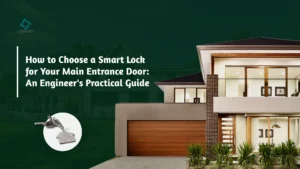
Beyond the Hype - Engineering Your Front Door Security
Upgrading your main entrance with a smart lock is one of the best decisions for your home’s security and convenience. However, the market is flooded with options that all look similar but hide critical differences in their internal engineering. For your front door—the primary barrier protecting your home—you need more than just a list of app features; you need a device built to withstand real-world use and attempted forced entry.
This guide bypasses the marketing jargon to give you a practical, engineering-focused framework. We will break down the three most critical, often overlooked aspects of a durable smart lock for main entrance door: the motor torque that drives it, the lock body that secures it, and the materials that protect it.
The Heart of the Lock - Why Motor Torque is King
Let’s be clear: the vast majority of smart locks on the market, including many high-end models, use high-quality, precision micro brushed DC motors. The key differentiator isn’t the motor type itself, but its engineering and torque output.
Why Motor Torque is Non-Negotiable: Torque is the rotational force that physically throws the deadbolt. Your front door lock must overcome friction from weather stripping, door sag, and potential ice or debris. A low-torque motor may struggle, leading to a partially thrown bolt, a jarring noise, or a complete failure to lock—leaving your home vulnerable.
The Reality: A weak motor is the hidden cause of many “smart lock failures.” It’s not that the electronics are faulty; it’s that the physical engine isn’t up to the task.
Beyond the Brush: How to Gauge a Motor’s True Capability:
Look for “High-Torque” Design: Reputable manufacturers will explicitly design and label their motors for high-torque output. This involves using better magnetic materials, optimized gearbox designs, and robust power delivery circuits.
Listen and Feel: A quality high-torque motor should sound smooth and decisive when locking, not strained or grinding. The action should feel confident.
Practical Takeaway: Don’t get caught up in the “brushed vs. brushless” debate for standard lock applications. Instead, focus on finding a lock from a brand that prioritizes and verifies high-torque motor performance through rigorous testing. This is the single most important factor for reliable daily operation.
LEROND’s Engineering Focus: We are transparent about our technology. We use custom-wound, high-torque brushed DC motors in our locks. Why? Because we have engineered them to deliver exceptional force, capable of handling heavy deadbolts and real-world door conditions with ease. Each LEROND motor is subjected to a 200,000-cycle endurance test under load to guarantee this performance for years.
The Foundation of Security - Lock Body Types Explained
The smart module is useless if the physical lock body it’s attached to is weak.
Mortise Lock Body: The Gold Standard for Security
What it is: A rectangular lock body that is embedded (mortised) into the edge of the door itself. This creates a massively strong, integrated system.
Why it’s superior: It utilizes multiple locking points (bolts) at the top, bottom, and side of the door, making it extremely resistant to kick-ins and forced entry. This is the standard for high-security applications in Europe and is increasingly popular globally for premium residential doors.
Cylindrical Lock Body: The Common Retrofit Option
What it is: A rounded lock body that fits into a single bore hole drilled through the door. It’s the most common type in North America.
Considerations: While convenient for DIY installation, it generally relies on a single latch and deadbolt, making it inherently less robust than a multi-point mortise system. The strength heavily depends on the quality of the door and the strike plate.
LEROND’s Perspective: For ultimate peace of mind on your main entrance, we strongly advocate for smart locks built on a mortise lock body platform. The integrated strength is unmatched. For instance, our LEROND LR-LK-VL03 is designed around a robust mortise system, ensuring that the smart convenience is backed by superior physical security.
Built to Endure - A Guide to Materials and Weatherproofing
Your front door lock faces the elements every day. The materials determine its lifespan and appearance.
Exterior Finish: The First Line of Defense
Zinc Alloy: The most common material. A high-quality, thick zinc alloy with a good surface coating (e.g., PVD coating) offers decent durability and corrosion resistance for most climates.
Stainless Steel: The premium choice. Stainless steel (especially Grade 304) offers superior strength, exceptional resistance to rust and corrosion, and a robust, modern feel. It is the best material for withstanding physical attacks and harsh weather, particularly in coastal areas.
Weatherproofing: Don’t Just Look for “Weather Resistance”
Demand the IP Code: The IP (Ingress Protection) rating is a standardized measure of a product’s sealing effectiveness.
IP65: Dust-tight and protected against water jets from any direction. This is the ideal rating for a main entrance door smart lock exposed to rain, dust, and snow.
IP54: Protected against dust and water splashes from any direction. This is a good, minimum standard for most homes.
Internal Sealing: High-quality locks have internal gaskets to protect the electronic circuitry from humidity and temperature changes, which is crucial for preventing failures.
Your Main Entrance Smart Lock Checklist
Use this actionable list to compare models:
Motor: Does the brand emphasize a high-torque, reliably tested motor design?
Lock Body: Is it based on a secure mortise lock body system?
Materials: Is the external finish made of stainless steel or high-grade zinc alloy?
Weatherproofing: Does it have a clear IP54 or IP65 weatherproof rating?
Anti-Drill Features: Does it incorporate hardened steel inserts in the lock cylinder and bolt to resist drilling?
Battery Backup: Is there a physical key override or a 9V battery emergency power port?
Why LEROND Locks are Built Different: We believe in engineering transparency. We design and test our locks to exceed the underlying principles of durability and security. The LEROND Fortis S1, for example, undergoes a 200,000-cycle endurance test on its high-torque motor and is subjected to salt spray testing to validate its stainless steel housing. Link to the page on the LEROND quality assurance process.
Frequently Asked Questions (FAQ)
Q1: Is a smart lock secure enough for my main front door?
A: Absolutely. A well-engineered smart lock for main entrance door that uses a mortise lock body, a high-torque motor, and robust materials can be more secure than a traditional lock. It combines strong physical security with digital features like tamper alarms and unique access codes, eliminating the risk of copied keys.
Q2: I’ve heard brushed motors wear out. Is this a problem?
A: All mechanical components have a finite lifespan. However, a high-quality brushed motor engineered for high torque and longevity (like those used in LEROND locks, tested to 200,000 cycles) will far outlive the practical lifespan of most other electronic components in the lock. For context, 200,000 cycles equates to over 27 years of use at 20 locks/unlocks per day.
Q3: How do I know if a lock is truly weatherproof?
A: Look for a published IP rating on the product specification sheet, not just “weatherproof” in the marketing copy. An IP65 rating is your best guarantee of durability against rain and dust.
Conclusion: Engineer Your Choice, Don't Just Make One
Choosing a smart lock for your main entrance door is an investment in your home’s security infrastructure. By looking beyond app features and focusing on the core engineering principles—a powerful and proven high-torque motor, a secure mortise lock body, and durable, weather-sealed materials—you can select a lock that delivers not just convenience, but proven, long-term reliability and peace of mind.
Ready to experience a smart lock engineered for the real world? Explore the LEROND collection, where every product is built with the high-torque motors, robust lock bodies, and premium materials that your front door deserves. Discover our main entrance smart lock solutions here.