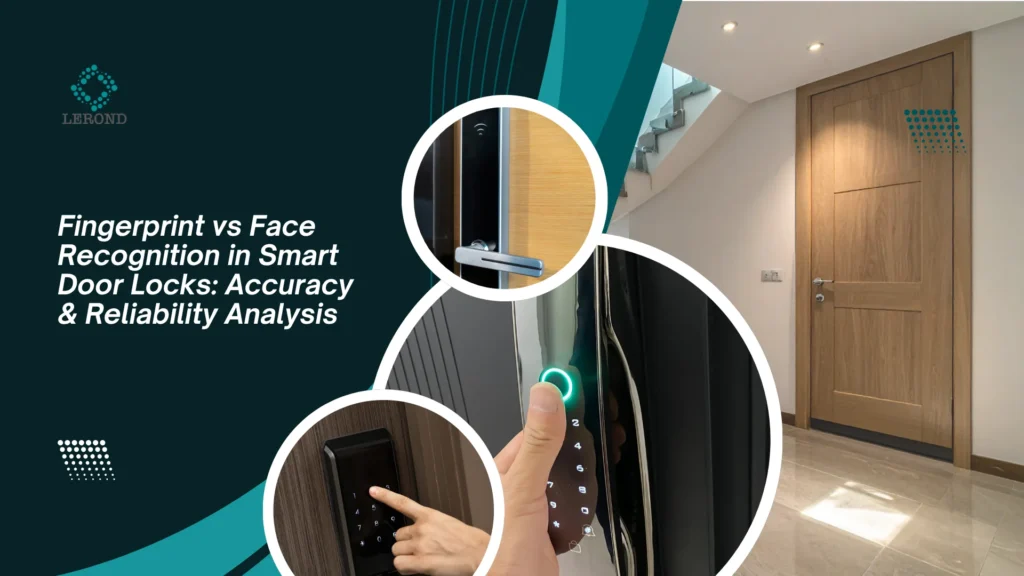
Understanding Biometric Authentication in Smart Door Locks
Biometric authentication has become one of the most important innovations in modern access control. Unlike traditional keys or passcodes, biometric systems verify a user’s identity based on unique physical characteristics such as fingerprints or facial features. This approach significantly reduces the risk of unauthorized access while improving convenience for everyday users.
In the context of residential and commercial security, biometric technology is increasingly integrated into modern smart door locks, allowing users to unlock doors with a fingerprint, a facial scan, or other forms of biometric verification. These technologies eliminate the need to carry physical keys while providing a higher level of identity authentication.
As the adoption of smart access solutions grows worldwide, biometric unlocking methods have become a core feature in advanced smart door lock systems designed for apartments, villas, offices, and commercial buildings.
However, not all biometric technologies perform the same way in real-world environments. Among the most widely used options today are fingerprint recognition and face recognition. Each method uses different sensing technologies, accuracy algorithms, and environmental detection capabilities.
Understanding the strengths and limitations of these technologies is essential when selecting biometric access solutions within modern smart door locks.
How Fingerprint Recognition Works in Smart Door Locks
Fingerprint recognition is the most widely adopted biometric technology in smart locks today. It relies on scanning the unique ridge patterns on a person’s fingertip and comparing them to stored biometric templates inside the lock’s internal memory.
Because fingerprints are highly distinctive—even among identical twins—this technology provides a reliable method of identity verification for secure door access.
Fingerprint Sensor Technologies
Modern smart locks typically use one of three fingerprint sensor types:
Capacitive Sensors
Capacitive sensors are the most common technology used in smart locks. These sensors detect electrical signals generated by the ridges and valleys of a fingerprint. Because human skin conducts electricity, the sensor can map fingerprint patterns with high precision.
Advantages include:
High accuracy
Fast recognition speed
Strong resistance to surface contamination
For this reason, capacitive fingerprint modules are widely used in premium biometric smart door locks.
Optical Sensors
Optical fingerprint sensors capture an image of the fingerprint using a small camera and light source. The image is then analyzed by pattern-recognition software to identify ridge structures.
While optical sensors were commonly used in early biometric systems, they are less common in modern smart locks because they can be more vulnerable to spoofing attempts using printed images.
Ultrasonic Sensors
Ultrasonic fingerprint sensors use high-frequency sound waves to map the three-dimensional structure of a fingerprint. This technology can capture deeper skin layers and is more resistant to surface damage or contamination.
Although ultrasonic sensors offer extremely high accuracy, they are still relatively expensive and are more commonly used in high-end biometric devices.
Accuracy Metrics of Fingerprint Locks
The performance of fingerprint recognition systems is usually measured using two industry-standard metrics:
False Acceptance Rate (FAR)
This indicates how often an unauthorized fingerprint is incorrectly accepted by the system.
False Rejection Rate (FRR)
This measures how often a legitimate user’s fingerprint is rejected.
High-quality fingerprint smart locks typically achieve:
| Metric | Typical Performance |
|---|---|
FAR |
0.001% – 0.0001% |
FRR |
1% – 3% |
These figures indicate that fingerprint recognition provides a very reliable authentication mechanism when properly implemented.
In many modern smart door lock systems, advanced fingerprint algorithms also include adaptive learning, allowing the lock to refine stored fingerprint data over time and improve recognition accuracy.
Strengths and Limitations of Fingerprint Unlocking
Fingerprint unlocking has become popular largely because of its balance between security, speed, and usability.
Key advantages include:
Fast unlocking (typically under 0.5 seconds)
High biometric uniqueness
Mature sensor technology
Minimal lighting requirements
Because fingerprint recognition relies on touch-based input rather than visual scanning, it works reliably in low-light environments and indoor installations.
However, fingerprint technology also has certain limitations.
Environmental conditions can sometimes affect sensor performance. For example:
Wet fingers
Extremely dry skin
Dust or oil contamination
In outdoor installations—such as gate locks or exposed entrance doors—these factors may occasionally affect fingerprint recognition performance.
Additionally, fingerprint authentication requires physical contact with the device, which may not always be ideal in high-traffic environments or for users who prefer completely contactless access.
For this reason, some advanced modern smart door lock technology now integrates additional biometric options such as facial recognition to improve accessibility and convenience.
In the next section, we will explore how face recognition technology works in smart door locks and how it compares to fingerprint authentication in terms of accuracy, reliability, and environmental performance.
How Face Recognition Works in Smart Door Locks
Face recognition is a contactless biometric authentication method that identifies users by analyzing facial structures and patterns. Instead of scanning a fingerprint, the system captures an image of a person’s face and compares it to encrypted biometric data stored in the lock.
Because facial recognition does not require physical contact, it has become increasingly popular in modern biometric smart door locks, especially for high-end residential entrances, office buildings, and villa gates.
This technology is particularly useful in situations where convenience and speed are important, as users can unlock the door simply by approaching the lock.
However, the performance of facial recognition depends heavily on the sensing technology used in the device.
2D vs 3D Face Recognition Technology
Not all facial recognition systems operate the same way. In smart locks, two main technologies are commonly used: 2D facial recognition and 3D facial recognition.
2D Face Recognition
2D systems analyze facial features using a standard camera image. The system measures distances between facial landmarks such as:
Eyes
Nose
Mouth
Jawline
While this approach is relatively simple and inexpensive, it has limitations. Because it relies on flat images, 2D recognition systems may be vulnerable to spoofing attempts using printed photos or digital images.
For this reason, 2D facial recognition is rarely used in advanced smart door locks designed for high-security applications.
3D Face Recognition
3D facial recognition systems are significantly more secure and accurate. These systems use infrared sensors or structured light technology to create a three-dimensional depth map of the user’s face.
The lock captures thousands of data points that represent the shape and depth of facial features. This depth information allows the system to distinguish between a real human face and flat images or videos.
Many modern smart door lock systems incorporate 3D infrared recognition combined with liveness detection algorithms, which analyze subtle movements such as blinking or facial micro-expressions to prevent spoofing attacks.
Because of these features, 3D facial recognition has become the preferred biometric technology in premium smart lock solutions.
Accuracy and Environmental Factors
Facial recognition accuracy depends on several technical and environmental factors.
Advanced facial recognition locks typically achieve recognition accuracy rates of 98–99%, depending on the algorithm and sensor quality.
However, environmental conditions can influence performance.
Key factors include:
lighting conditions
camera angle
distance between the user and the lock
outdoor sunlight exposure
To address these challenges, many modern smart door lock systems now integrate infrared recognition, allowing facial detection even in complete darkness.
Infrared sensors illuminate the face with invisible light, enabling accurate recognition regardless of ambient lighting conditions.
Despite these improvements, facial recognition still performs best when the user stands within a defined detection range and faces the lock directly.
Fingerprint vs Face Recognition: Accuracy Comparison
Both fingerprint and facial recognition technologies offer strong biometric security, but they differ in terms of reliability, convenience, and environmental adaptability.
The following table summarizes the key differences between the two technologies when implemented in modern smart door locks.
| Feature | Fingerprint Recognition | Face Recognition |
|---|---|---|
Authentication Type |
Touch-based |
Contactless |
Average Accuracy |
99%+ |
98–99% |
Unlock Speed |
~0.3–0.5 sec |
~0.2–0.4 sec |
Lighting Requirements |
None |
May require IR support |
Wet or Dirty Hands Impact |
Possible |
None |
Spoof Resistance |
High |
Very high (with 3D detection) |
User Convenience |
Good |
Excellent |
From a purely technical perspective, both biometric methods provide strong authentication reliability. However, their real-world performance may vary depending on the environment and user behavior.
Fingerprint recognition is extremely accurate and performs consistently in indoor conditions. Because it relies on physical contact rather than visual detection, it is not affected by lighting conditions.
Facial recognition, on the other hand, offers a fully contactless experience, which many users find more convenient—especially when carrying bags, packages, or groceries.
Reliability in Real-World Scenarios
When evaluating biometric technologies for smart door locks, accuracy alone is not enough. Real-world reliability is equally important.
Different environments can affect how biometric systems perform in daily use.
Outdoor Environment Performance
Outdoor installations present unique challenges for biometric smart locks.
For fingerprint sensors, environmental factors such as rain, dust, or moisture may occasionally affect fingerprint readability. If a user’s finger is wet or extremely dry, the sensor may need multiple attempts to authenticate the fingerprint.
Facial recognition systems typically perform better in these situations because they do not require physical contact.
However, strong sunlight or extreme backlighting can sometimes affect camera-based recognition systems unless infrared sensors are included.
Many premium modern smart door lock technology solutions therefore combine infrared recognition with adaptive exposure control to maintain reliable performance in outdoor conditions.
Wet Hands vs Low-Light Conditions
A common real-world comparison between these technologies involves two everyday situations:
Wet or Dirty Hands
Fingerprint sensors may occasionally struggle to detect fingerprint patterns when the finger surface is covered by water, oil, or dirt.
Facial recognition systems are not affected by these conditions because they rely on visual scanning rather than physical contact.
Low-Light Environments
In dark environments, fingerprint sensors perform normally because they rely on electrical or ultrasonic detection rather than light.
Facial recognition locks require infrared sensors to function reliably in darkness. Most modern smart door locks now include IR illumination specifically for this purpose.
User Experience in Daily Access
From a user experience perspective, facial recognition is often perceived as more convenient.
Users simply approach the lock and the door unlocks automatically without touching the device.
Fingerprint locks require a deliberate touch action, which may feel slightly less convenient but still offers fast and reliable access.
Because both technologies have distinct strengths, many modern biometric smart door locks now integrate multiple authentication methods, allowing users to choose between fingerprint, facial recognition, PIN codes, or mobile app unlocking.
This multi-authentication approach improves both reliability and accessibility in real-world installations.
Which Biometric Technology Is More Secure?
Security is one of the primary reasons why biometric authentication has become popular in modern smart door locks. Unlike traditional keys or PIN codes, biometric credentials are extremely difficult to duplicate because they rely on unique physical characteristics.
However, the level of security provided by biometric authentication depends largely on the underlying technology and the protection mechanisms implemented within the lock system.
Both fingerprint and facial recognition technologies include several layers of protection designed to prevent unauthorized access.
Spoofing Protection
A common concern with biometric systems is the possibility of spoofing attacks, where an attacker attempts to bypass the authentication system using fake biometric samples.
For fingerprint locks, potential spoofing attempts may include:
silicone fingerprint molds
lifted fingerprints from surfaces
artificial fingerprint films
To mitigate these risks, modern fingerprint smart locks use high-resolution capacitive sensors combined with anti-spoofing algorithms. These systems detect subtle electrical characteristics of human skin, making it extremely difficult for fake fingerprints to pass authentication.
Facial recognition systems rely on different protection mechanisms.
Advanced face recognition locks use 3D depth mapping and infrared sensors to distinguish between a real human face and a flat image or video. Many systems also integrate liveness detection, which analyzes micro-movements such as blinking, breathing patterns, or facial muscle activity.
Because of these additional verification layers, premium facial recognition locks in modern smart door lock systems often provide extremely strong resistance to spoofing attempts.
Biometric Data Protection
Another important aspect of biometric security is how the lock stores and processes biometric data.
High-quality smart door locks typically store biometric templates locally within the device rather than uploading them to external servers. The system converts biometric data into encrypted mathematical models rather than storing raw images of fingerprints or faces.
This design offers several advantages:
biometric data never leaves the device
user privacy is better protected
the risk of remote data breaches is minimized
Some advanced biometric smart door locks also integrate secure encryption chips to protect stored biometric templates against physical tampering.
These architectural protections are part of the overall security design of modern smart door lock systems, which combine hardware encryption, biometric verification, and multiple authentication methods.
Which One Should You Choose for Your Smart Door Lock?
Choosing between fingerprint and facial recognition technology ultimately depends on the intended installation environment and user preferences.
Both technologies offer reliable biometric authentication, but they perform differently in certain real-world scenarios.
The following table summarizes recommended applications for each technology.
| Installation Scenario | Recommended Technology | Reason |
|---|---|---|
Apartment entrance |
Fingerprint lock |
Stable indoor environment |
Villa or outdoor gate |
Face recognition |
Contactless access and weather tolerance |
Office or commercial building |
Either |
Depends on user traffic patterns |
Elderly users |
Face recognition |
Hands-free unlocking |
High-security residential door |
Fingerprint + multi-authentication |
Higher authentication redundancy |
For residential applications, fingerprint locks remain one of the most popular solutions because of their accuracy, reliability, and cost efficiency.
However, facial recognition technology is becoming increasingly popular in premium smart lock solutions because of its contactless convenience and fast unlocking speed.
Many advanced modern smart door lock technology solutions now integrate multiple authentication methods, allowing users to combine fingerprint recognition, facial recognition, PIN codes, RFID cards, and mobile apps within the same system.
This multi-authentication approach improves both flexibility and reliability, ensuring that users always have alternative unlocking methods available.
The Future of Biometric Smart Door Locks
Biometric authentication technologies are evolving rapidly, and the next generation of smart door locks will likely incorporate even more advanced biometric identification methods.
One major trend is the development of multi-biometric authentication, where multiple biometric inputs are combined to improve security.
For example, a smart lock may require:
fingerprint + facial recognition
facial recognition + mobile authentication
fingerprint + PIN verification
This layered authentication approach significantly increases security while maintaining user convenience.
Another emerging technology is palm vein recognition, which analyzes vein patterns beneath the skin using infrared imaging. Because vein structures are internal and difficult to replicate, palm vein authentication offers extremely high levels of biometric security.
Artificial intelligence is also improving the accuracy of facial recognition systems. AI-based recognition algorithms can now adapt to changes in facial appearance caused by:
aging
glasses
facial hair
lighting variations
These advancements are expected to further enhance the reliability and security of future smart door locks.
Frequently Asked Questions
Are fingerprint smart locks more secure than facial recognition locks?
Both technologies can provide very high security when implemented properly. Fingerprint locks rely on highly unique biometric patterns and mature sensor technology, while facial recognition locks often incorporate 3D depth mapping and liveness detection. In practice, the overall security level depends more on the lock’s hardware design and encryption architecture than on the biometric method itself.
Do face recognition smart locks work in complete darkness?
Yes, most modern facial recognition locks use infrared sensors that illuminate the user’s face with invisible light. This allows the system to detect facial features even in complete darkness, making the technology suitable for nighttime use.
What happens if a fingerprint sensor cannot recognize a fingerprint?
If fingerprint recognition fails due to wet fingers, dirt, or skin dryness, users can typically unlock the door using alternative methods such as a PIN code, RFID card, mobile app, or mechanical key. Most smart door locks support multiple unlocking methods to ensure reliable access.
Can biometric smart locks be hacked?
Like any electronic device, smart locks must be designed with strong security architecture. Reputable biometric smart locks use encrypted communication, secure chips, and locally stored biometric templates to reduce the risk of hacking. Systems that follow modern smart door lock systems architecture typically include multiple layers of security protection.
Which biometric method unlocks faster?
Both technologies are very fast. Facial recognition can unlock the door in as little as 0.2 seconds, while fingerprint recognition usually takes around 0.3–0.5 seconds. In real-world use, the difference is usually negligible.
Are biometric smart locks suitable for outdoor installations?
Yes, but the lock must be designed for outdoor environments. Weather-resistant biometric locks include sealed sensors, temperature-resistant components, and protective coatings to ensure stable operation in rain, dust, or extreme temperatures.
Do biometric locks store personal biometric images?
No. Most smart locks convert biometric inputs into encrypted digital templates rather than storing raw images of fingerprints or faces. These templates cannot be used to reconstruct the original biometric data.
Should a smart door lock support multiple biometric methods?
Yes. Many experts recommend choosing smart locks that support multiple authentication methods. Combining fingerprint, facial recognition, PIN codes, and mobile apps ensures that users always have a reliable unlocking option available.
Explore Advanced Smart Door Lock Systems
Understanding the differences between biometric technologies is an important step when selecting the right access solution.
If you want to learn more about system architecture, access technologies, and real-world deployment strategies, explore our complete smart door lock systems guide.
This comprehensive resource explains how modern smart door locks integrate biometric authentication, connectivity protocols, and multi-layer security to provide reliable access control for residential and commercial environments.
Discover Professional Smart Door Locks
Biometric authentication continues to redefine how people interact with door security systems.
Explore the latest smart door locks designed for modern homes, villas, and commercial entrances, including advanced solutions that combine fingerprint recognition, facial recognition, and multi-factor authentication technologies.
high-traffic commercial. Full OEM/ODM technical support.