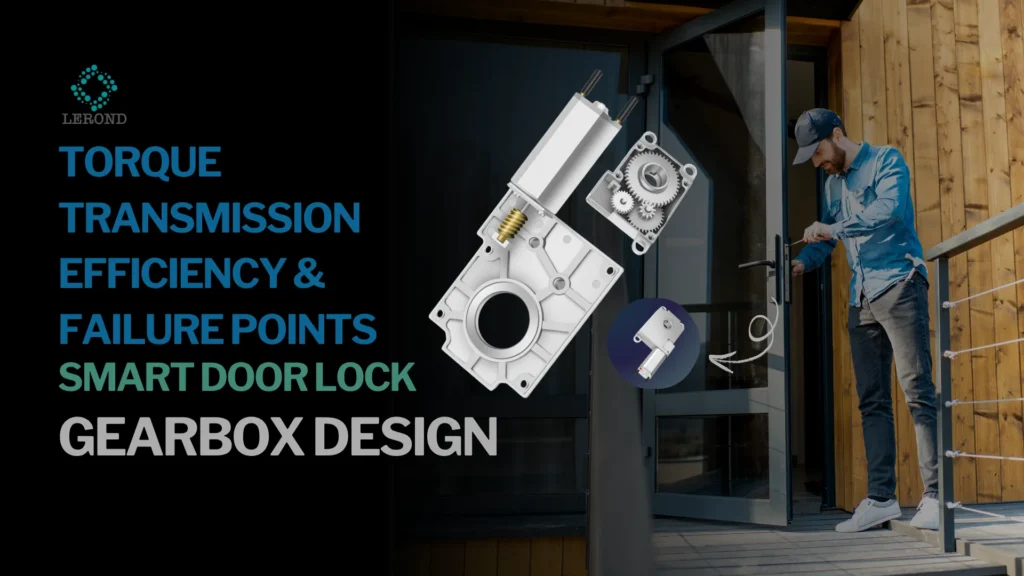
Why a Powerful Motor Doesn’t Guarantee Smooth Unlocking
In smart door lock development, motor torque is often treated as the primary indicator of performance. On paper, a higher torque motor should deliver stronger driving force and more reliable unlocking.
But in real-world applications, that assumption frequently fails.
It is not uncommon to see smart locks with “sufficient” motor torque still exhibiting issues such as:
- Jerky or delayed unlocking
- Abnormal mechanical noise during operation
- Increased resistance after several months of use
- Complete jamming under minor misalignment conditions
From a purely motor-centric perspective, these failures are difficult to explain.
The reason is simple:
Torque generation and torque delivery are two fundamentally different engineering problems.
A motor may generate enough torque, but whether that torque can be:
- efficiently transmitted,
- evenly distributed, and
- consistently maintained over time
depends almost entirely on the gear transmission system inside the lock.
In other words,
The motor defines the upper limit of force.
The gearbox defines how much of that force actually reaches the lock mechanism.
This is why, in many field failures, replacing the motor does not solve the problem — but redesigning the gearbox does.
For a deeper understanding of how the overall mechanism works, you can refer to how a smart door lock works internally, where the complete mechanical chain is explained from motor to locking components.
The Hidden Role of Gearboxes in Smart Door Locks
In most smart locks, the motor does not directly drive the deadbolt or latch. Instead, it connects to a gear reduction system (gearbox) that performs two critical functions:
Torque Amplification
Small DC motors used in smart locks typically operate at high speed but relatively low torque.
The gearbox converts:
- high-speed / low-torque input
into - low-speed / high-torque output
This transformation is essential because lock mechanisms require:
- high force to overcome friction and sealing pressure
- controlled movement to avoid impact and wear
Controlled Motion & Stability
Beyond torque conversion, the gearbox stabilizes motion:
- Reduces sudden load spikes
- Smooths rotational output
- Enables predictable engagement with the lock body
Without a properly designed gearbox:
- The motor output becomes unstable
- Mechanical shocks increase
- Wear accelerates across the entire system
Mechanical Interface Between Electronics and Lock Body
The gearbox is the bridge between the electronic system and the mechanical locking structure.
It connects:
- motor shaft
→ gear stages
→ clutch or actuator
→ deadbolt / latch system
Any inefficiency or misalignment in this chain will propagate forward, amplifying problems at the locking point.
From an engineering perspective, this is why gearbox design must be evaluated as part of the smart door lock system design principles, rather than treated as an isolated component.
How Torque Is Transmitted Inside a Smart Lock Gear System
To understand why some locks feel smooth while others degrade quickly, we need to look at how torque actually flows through the gearbox.
Multi-Stage Gear Reduction
Most smart locks use multi-stage gear trains, typically consisting of 2–4 reduction stages.
Each stage:
- reduces rotational speed
- increases torque
- introduces a small efficiency loss
A simplified transmission path looks like this:
Motor → Pinion Gear → Intermediate Gears → Final Drive Gear → Lock Mechanism
Gear Ratio and Its Trade-offs
The total gear ratio determines:
- output torque
- unlocking speed
- mechanical stress distribution
Higher gear ratios:
- increase torque output
- reduce speed
- improve ability to handle heavy loads
But they also:
- increase friction losses
- introduce more wear points
- amplify tolerance accumulation errors
Lower gear ratios:
- provide faster response
- reduce internal complexity
but may struggle under: - door misalignment
- high sealing pressure
- multi-point locking resistance
This is where many low-cost designs fail — they optimize for speed and cost, but sacrifice long-term reliability.
Where Torque Gets Lost
Even with a well-sized motor and proper gear ratio, not all generated torque reaches the lock mechanism.
Torque losses occur at multiple points:
• Gear Meshing Friction
Every gear contact introduces sliding and rolling friction.
Poor surface finish or inaccurate tooth profiles significantly increase loss.
• Alignment Errors
Shaft misalignment or housing deformation leads to uneven load distribution, causing:
- localized wear
- increased resistance
- noise generation
• Material Deformation
Plastic gears under continuous load may experience micro-deformation, reducing transmission efficiency over time.
• Lubrication Degradation
As lubrication ages or migrates:
- friction increases
- wear accelerates
- noise becomes more noticeable
Efficiency vs Durability: The Real Engineering Balance
In theory, a gearbox can be optimized for maximum efficiency.
In practice, smart lock design must balance:
- efficiency
- durability
- noise control
- cost constraints
A gearbox with:
- high efficiency but low wear resistance
will perform well initially, but degrade quickly.
A gearbox with:
- conservative design and better materials
may have slightly lower efficiency, but maintain stable performance over years.
This trade-off is often invisible in specifications, but very obvious in long-term user experience.
Gear Materials & Structural Design: What Really Impacts Durability
In smart lock gearbox design, material selection is not just a cost decision — it directly defines how the system behaves under load, over time, and across different environments.
At a glance, most gear systems fall into three categories:
- Engineering plastics (POM, Nylon)
- Powder metallurgy (sintered metal)
- Machined metal (steel, brass)
But the real difference is not the material itself —
it is how the material interacts with load cycles, friction, and dimensional stability.
📊 Gear Material Comparison in Smart Locks
| Gear Type | Typical Material | Noise Level | Wear Resistance | Impact Resistance | Cost | Typical Use Case |
|---|---|---|---|---|---|---|
Plastic Gear |
POM / Nylon |
Very Low |
Medium–Low |
High (flexible) |
Low |
Entry-level smart locks |
Powder Metallurgy Gear |
Sintered Steel |
Medium |
Medium–High |
Medium |
Medium |
Mid-range locks |
Machined Metal Gear |
Steel / Brass |
Higher (if untreated) |
High |
High |
High |
High-end / heavy-duty locks |
Plastic Gears: Quiet but Structurally Limited
Plastic gears are widely used because they:
- reduce noise
- lower cost
- absorb minor impact loads
However, their limitations become obvious over time:
- Creep deformation under constant load
→ tooth profile gradually changes - Lower wear resistance
→ increased backlash and slipping - Sensitivity to temperature
→ stiffness varies across environments
This is why many low-cost locks feel smooth at first, but:
- develop play in the mechanism
- start producing “clicking” or “skipping” sounds
after several months of use
Powder Metallurgy Gears: Balanced but Process-Dependent
Powder metallurgy gears offer a compromise:
- stronger than plastic
- cheaper than machined metal
But their performance depends heavily on:
- density consistency
- sintering quality
- surface finishing
Common issues include:
- micro-porosity → reduced fatigue strength
- surface roughness → higher friction
- inconsistent tolerances → uneven load distribution
If not well controlled, these gears may:
- wear faster than expected
- produce increasing noise over time
Machined Metal Gears: Durable but Demanding
Machined gears (steel or brass) provide:
- high strength
- excellent wear resistance
- stable geometry over long cycles
However, they introduce new challenges:
- Noise control
Metal-to-metal contact requires precise finishing and lubrication - Cost sensitivity
Material + machining + assembly cost is significantly higher - Shock transmission
Less damping compared to plastic → higher impact stress if poorly designed
In well-designed systems, these gears deliver:
- long service life
- consistent torque transmission
- minimal performance degradation
Structural Design Factors Beyond Material
Material alone does not determine gearbox performance.
Structural design plays an equally critical role.
Key factors include:
• Gear Module & Tooth Profile
- Determines load distribution
- Poor design → stress concentration → early wear
• Number of Gear Stages
- More stages → higher torque output
- But also:
- more friction points
- more tolerance stacking
• Shaft Support & Housing Rigidity
- Weak support leads to:
- misalignment
- uneven tooth engagement
- noise and wear
• Backlash Control
- Too tight → friction and jamming
- Too loose → noise and impact wear
These parameters are rarely visible in product specs,
but they define real-world reliability.
Common Gearbox Failure Points in Smart Door Locks
From field data and after-sales analysis, most gearbox-related failures fall into a few predictable categories.
Understanding these failure modes is critical for both product selection and engineering evaluation.
Gear Slipping (Tooth Skipping)
What it feels like:
- Clicking or “ratcheting” sound
- Lock fails to fully engage or retract
Root causes:
- Worn gear teeth
- Excessive backlash
- Plastic deformation under load
Engineering implication:
- Torque is no longer effectively transmitted
- System loses positional accuracy
Long-term result:
- Complete failure to lock/unlock
- Increased risk of security issues
Gear Wear (Progressive Degradation)
What it feels like:
- Increasing noise over time
- Reduced smoothness in operation
Root causes:
- Poor material selection
- Inadequate lubrication
- high-frequency operation cycles
Engineering implication:
- Gradual loss of transmission efficiency
- Increased load on motor
Long-term result:
- Higher energy consumption
- accelerated failure of other components
Gear Jamming (Mechanical Lock-Up)
What it feels like:
- Sudden stop during operation
- motor stalls or retries repeatedly
Root causes:
- Misalignment of gear shafts
- debris or contamination
- deformation of gear housing
Engineering implication:
- system exceeds motor capacity
- risk of motor burnout
Long-term result:
- complete lock failure
- costly replacement rather than repair
Misalignment & Tolerance Accumulation
What it feels like:
- inconsistent performance
- sometimes smooth, sometimes stuck
Root causes:
- poor assembly precision
- weak structural rigidity
- thermal expansion differences
Engineering implication:
- uneven load distribution
- localized stress on gear teeth
Long-term result:
- unpredictable failure patterns
- difficult troubleshooting in field conditions
Lubrication Failure
What it feels like:
- increased noise
- rough or “dry” mechanical feedback
Root causes:
- lubricant migration or drying
- incompatible materials
- poor sealing design
Engineering implication:
- friction coefficient increases significantly
- wear rate accelerates
Long-term result:
- rapid degradation of gearbox
- shortened product lifecycle
Why These Failures Are Often Misdiagnosed
In many cases, gearbox-related issues are incorrectly attributed to:
- motor weakness
- electronic control problems
- battery performance
This leads to:
- ineffective troubleshooting
- unnecessary component replacement
In reality, these symptoms often originate from mechanical transmission inefficiencies, not the motor itself.
Why Smart Locks Become Noisy or Stiff Over Time
One of the most common field complaints about smart locks is not immediate failure, but gradual performance degradation.
Users rarely say:
“The gearbox failed.”
Instead, they report:
- “It’s getting louder”
- “It doesn’t feel smooth anymore”
- “Sometimes it struggles to unlock”
These symptoms are not random — they are the visible results of internal mechanical changes.
Backlash Growth Over Time
As gears wear, the gap between teeth (backlash) increases.
What happens:
- Initial smooth engagement becomes loose
- Micro-impacts occur between gear teeth
- Noise increases with each cycle
User perception:
- Clicking or rattling sound
- Reduced sense of mechanical precision
Lubrication Degradation
Lubricants inside compact gearboxes are subject to:
- temperature variation
- migration due to movement
- gradual drying or contamination
What happens:
- friction coefficient rises
- gear contact becomes less smooth
- wear accelerates non-linearly
User perception:
- “Dry” mechanical feeling
- higher resistance during unlocking
Material Fatigue & Micro-Deformation
Under repeated load cycles:
- plastic gears may deform
- metal gears may develop micro-pitting
What happens:
- tooth profiles change
- load distribution becomes uneven
- localized stress increases
User perception:
- inconsistent operation
- occasional resistance spikes
Structural Relaxation & Alignment Drift
Over time, internal components such as:
- shafts
- bearing points
- housings
may experience slight shifts due to:
- thermal cycles
- repeated mechanical stress
What happens:
- alignment precision decreases
- gear meshing becomes uneven
User perception:
- sometimes smooth, sometimes stuck
- unpredictable behavior
The Key Insight
These changes are gradual, but cumulative.
A smart lock rarely “fails suddenly.”
It degrades mechanically until failure becomes inevitable.
This is why long-term performance cannot be judged by:
- initial smoothness
- short-term testing
but must be evaluated through:
- structural design
- material stability
- lifecycle testing
How Gearbox Design Impacts Overall Lock Lifespan
From an engineering perspective, the gearbox is one of the most critical determinants of a smart lock’s service life.
Cycle Life vs Real Load Conditions
Manufacturers often specify:
- 100,000 cycles
- 200,000 cycles
But these numbers are typically tested under:
- ideal alignment
- controlled load
- stable temperature
In real installations:
- door misalignment
- sealing pressure
- environmental exposure
increase mechanical stress significantly.
A well-designed gearbox accounts for these variables by:
- adding torque margin
- selecting wear-resistant materials
- ensuring structural rigidity
Load Distribution Across the System
A gearbox does not just transmit torque — it distributes load.
Poor distribution leads to:
- concentrated stress on specific gears
- accelerated localized wear
- early failure of critical components
Good design ensures:
- even load sharing
- reduced peak stress
- longer overall system life
Interaction with Lock Body Mechanics
The gearbox must be matched with:
- deadbolt resistance
- latch mechanism
- door alignment conditions
If mismatched:
- gearbox compensates for external resistance
- internal wear increases rapidly
This is where many failures originate — not from the gearbox alone, but from system-level mismatch.
For a broader perspective on how these elements interact, refer to smart door lock system design principles, where mechanical and structural coordination is discussed in detail.
Design Margin & Reliability Engineering
High-reliability designs typically include:
- conservative gear loading
- safety factors in torque transmission
- tolerance for misalignment
Low-cost designs often:
- operate close to material limits
- lack redundancy
- degrade rapidly under real-world conditions
The difference is not visible in specifications —but becomes obvious after 6–12 months of use.
Engineering Considerations When Evaluating Smart Lock Gear Systems
For procurement teams and product managers, evaluating a smart lock should go beyond motor specs and feature lists.
Here are practical considerations that directly reflect gearbox quality:
Ask About Gear Materials (Not Just “Metal vs Plastic”)
- What specific materials are used? (POM, sintered steel, machined steel)
- Are critical load-bearing gears reinforced?
Evaluate Gear Staging & Transmission Design
- How many gear stages are used?
- Is the design optimized for torque margin or cost reduction?
Check Noise Evolution, Not Just Initial Noise
- Is there lifecycle noise testing data?
- Does noise increase significantly after 50k cycles?
Review Lifecycle & Durability Testing
- Under what conditions were cycle tests conducted?
- Are misalignment and load variations included?
Assess Structural Integration
- Is the gearbox rigidly supported?
- How is alignment maintained over time?
Understand Failure Mode Handling
- What happens if a gear slips or jams?
- Is there protection logic or mechanical fail-safe?
These questions often reveal more about product quality than any marketing specification.
If you want a complete framework for evaluating mechanical reliability across different designs, you can also explore LEROND smart door lock guide, which covers system-level considerations beyond individual components.
FAQ — Smart Door Lock Gearbox Design
Why does a high-torque smart lock still feel jerky or unstable?
Because torque generation does not guarantee smooth transmission.
If the gearbox has poor alignment, high friction, or worn gears, the output becomes inconsistent regardless of motor strength.
Are plastic gears always a bad choice in smart locks?
Not necessarily. Plastic gears can reduce noise and absorb shocks.
However, in high-load or high-cycle applications, they may deform or wear faster than metal alternatives.
How long does a smart lock gearbox typically last?
It depends on:
- material selection
- load conditions
- usage frequency
Well-designed gearboxes can exceed 100,000 cycles, but poor designs may degrade significantly within a year.
Why does a smart lock become noisier over time?
Main reasons include:
- increased backlash due to wear
- lubrication degradation
- uneven gear contact
Noise is often an early indicator of mechanical deterioration.
What causes a smart lock to suddenly jam?
Common causes:
- gear misalignment
- debris contamination
- severe wear or deformation
Jamming is usually the final stage of progressive mechanical failure.
Is gearbox maintenance required in smart locks?
Most smart locks are designed as sealed units without user maintenance.
However, internal lubrication and material quality determine how long they can operate without servicing.
Is a multi-stage gearbox always better than a single-stage design?
Not always.
Multi-stage systems provide higher torque but introduce more friction and wear points.
The optimal design depends on balancing torque needs and durability.
How can buyers identify a reliable gearbox without disassembling the lock?
Key indicators:
- consistent performance over time
- stable noise levels
- proven lifecycle testing data
- supplier transparency on materials and design
Conclusion: Gearbox Design Defines Long-Term Experience
In smart door locks, performance is not defined at the moment of installation.
It is defined over thousands of cycles, under varying loads, in real-world conditions.
And in that long-term perspective:
The gearbox is not just a transmission component —
it is the foundation of mechanical reliability.
A strong motor may create force,
but only a well-designed gearbox can deliver that force consistently, quietly, and over time.
Looking for smart door locks built for long-term mechanical performance?
Explore our engineering-driven solutions designed with gearbox reliability at the core.
high-traffic commercial. Full OEM/ODM technical support.