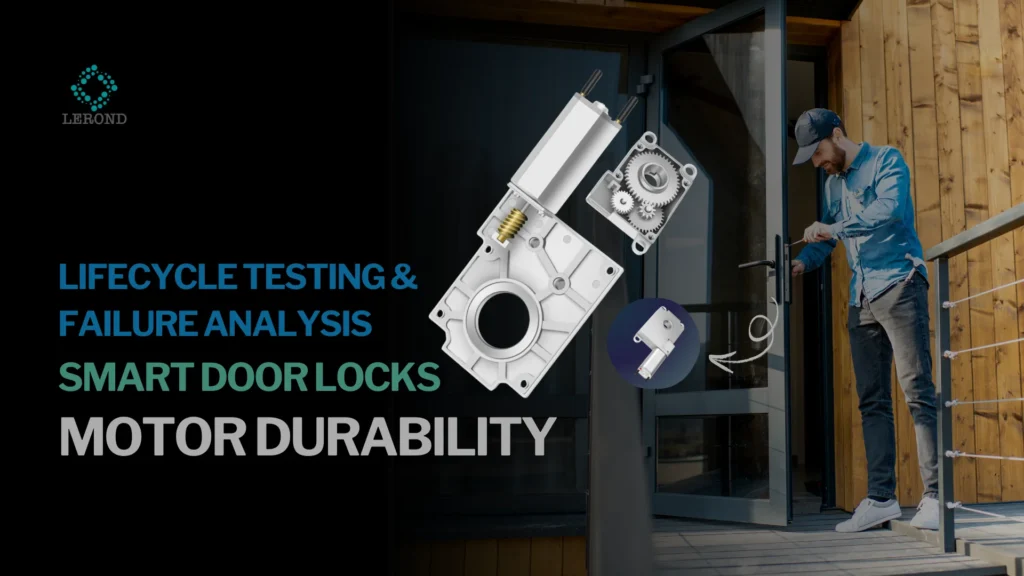
Why Motor Durability Is the Structural Backbone of Smart Locks
In modern smart door locks, most visible innovations happen in biometrics, connectivity, and app integration. However, from a mechanical engineering perspective, the true reliability bottleneck is not the fingerprint sensor or WiFi module — it is the motor assembly.
For distributors, importers, and project integrators, motor failure is statistically one of the most expensive after-sales risks.
A smart lock can survive:
Firmware bugs (fixable via OTA)
App compatibility issues
Minor cosmetic defects
But when the motor fails:
The latch cannot retract
The gearbox may jam
The user is locked out
On-site service becomes unavoidable
And for commercial projects — especially apartment developments or hospitality environments — this quickly escalates from “product defect” to “operational crisis.”
This is why motor durability must be treated as a primary structural criterion when evaluating smart door locks for long-term deployment.
The Hidden Failure Rate Behind Smart Lock Returns
In B2B after-sales analysis, motor-related problems typically fall into five categories:
Gear Wear and Material Fatigue
Many entry-level locks use nylon gears in compact gearboxes. While cost-efficient, these materials can experience:
Tooth edge rounding
Micro-cracks from cyclic stress
Heat deformation in high-temperature regions
Over 20,000–30,000 cycles, backlash increases. Eventually:
Torque transmission drops
Gear skipping occurs
Lock actuation becomes inconsistent
Durability is not determined by whether a motor works on Day 1 — but how it performs after tens of thousands of cycles.
Torque Drop Under Battery Voltage Decay
Unlike wired access systems, most smart locks rely on battery power.
As battery voltage drops:
Motor RPM decreases
Torque output declines
Stall current increases
If the lock design has minimal torque margin, low-battery conditions can:
Cause incomplete latch retraction
Trigger false motor overload errors
Accelerate gear wear
Professional-grade smart door lock systems are designed with torque redundancy — typically 30–50% above required latch resistance — to compensate for voltage fluctuations.
Without this margin, real-world durability suffers dramatically.
Brushed Motor Carbon Erosion vs Long-Term Stability
Many cost-sensitive designs still use DC brushed motors.
While affordable, they introduce long-term degradation mechanisms:
Carbon brush wear
Commutator pitting
Increased internal resistance
Over time, this results in:
Lower efficiency
Increased heat generation
Unstable torque output
In high-cycle environments, brush erosion becomes a predictable lifespan limiter.
Durability discussions must therefore include motor type — not just marketing claims.
Gearbox Backlash Accumulation
Gear precision and module accuracy directly influence lifecycle stability.
Poorly machined gearboxes accumulate:
Axial play
Radial misalignment
Uneven load distribution
Over thousands of cycles, this causes progressive torque instability.
From a B2B audit perspective, asking about gearbox tolerance specifications is not excessive — it is necessary risk control.
Lubrication Failure Under Temperature Cycles
Temperature cycling (-20°C to 60°C or wider) affects:
Lubricant viscosity
Gear expansion coefficients
Housing deformation
Inadequate lubrication systems may:
Harden in low temperatures
Thin excessively in hot climates
Accelerate wear under repeated stress
This is why serious lifecycle validation always includes temperature cycling combined with mechanical actuation testing — not static lab rotation.
Why Motor Durability Determines Project-Level ROI
For residential retail buyers, a motor failure is inconvenient.
For distributors managing thousands of deployed units, it becomes a cost structure problem:
On-site service labor
Replacement logistics
Reputation risk
Warranty claim inflation
When evaluating engineered smart door lock design for large-scale projects, lifecycle motor durability is directly tied to:
Maintenance cost forecasting
Failure rate modeling
Long-term profitability
In professional procurement scenarios, the question should not be:
“Does the lock work?”
It should be:
“How many full-load cycles can the motor deliver under real-world resistance conditions?”
That is the foundation of true durability analysis.
In the next section, we will break down:
What 50,000 vs 100,000 cycle testing actually means
How torque redundancy is engineered
How gear material selection affects lifecycle stability
And how B2B buyers can verify these claims before bulk purchase
What Does 50,000 vs 100,000 Cycle Testing Actually Mean?
When manufacturers claim:
“50,000 cycle tested”
“100,000 cycle durability validated”
Most buyers assume it simply means the lock opened and closed that many times.
In reality, the credibility of lifecycle testing depends on how the test was conducted.
Basic Rotation Test vs Real-Load Simulation
There are two very different testing standards in the market:
Level 1 – No-Load Motor Rotation Test
Motor spins without full latch resistance
No real door pressure
Stable lab temperature
Continuous bench test
This verifies motor functionality — but not durability under real conditions.
Level 2 – Full-Load Latch Actuation Test (Professional Standard)
Simulated latch resistance
Door misalignment compensation
Controlled temperature cycling
Battery voltage decay simulation
Only this type of testing reflects true long-term performance in commercial deployment.
When evaluating smart door lock systems, B2B buyers should always clarify:
Was the lifecycle test conducted under full mechanical load?
Because a 100,000-cycle no-load test is less meaningful than a 50,000-cycle full-load test.
Engineering Variables That Define Motor Durability
Motor durability is not determined by the motor alone.
It is the result of system-level engineering integration.
Below are the most critical structural variables.
Gear Material Selection
Gear wear is one of the primary lifespan limiters.
Common materials:
Nylon (cost-efficient, softer, higher deformation)
POM (Polyoxymethylene, better wear resistance)
Powder metallurgy metal gears
Full metal alloy gears
Each has trade-offs:
Nylon reduces noise but deforms faster
POM balances durability and smoothness
Metal gears provide high torque transfer but increase noise and cost
For mid-to-high durability applications, POM or reinforced composite gears often provide the best lifecycle stability-to-noise ratio.
Material choice directly affects:
Wear rate
Backlash growth
Long-term torque consistency
Torque Redundancy Design (The Most Overlooked Factor)
Every latch requires a certain torque to retract.
However, real-world conditions increase resistance due to:
Door misalignment
Seal compression
Weather expansion
Installation tolerance deviation
Low battery voltage
If a latch requires 0.8 Nm torque to retract, a professional-grade design may specify:
1.1–1.2 Nm operational output
30–50% torque redundancy
Without this buffer:
Motors operate near stall condition
Current spikes increase heat
Gear stress multiplies
Lifespan decreases exponentially
This is why high-durability smart door locks are engineered with torque margins rather than minimum functional output.
Brushed vs High-Efficiency DC Motor Architecture
Motor architecture impacts lifespan curve behavior.
Brushed DC Motor
Advantages:
Low cost
Simple structure
Limitations:
Brush wear
Carbon debris accumulation
Efficiency drop over time
High-Efficiency DC (Improved Brush Systems or Advanced Designs)
Advantages:
Lower internal friction
More stable torque curve
Reduced heat generation
Longer lifecycle consistency
While brushless systems are common in high-end industrial motors, most smart lock platforms optimize improved DC brushed systems with better carbon composition and precision commutators for cost-performance balance.
Durability is therefore not binary — it is about engineering quality within motor architecture.
Structural Comparison: Entry-Level vs Professional-Grade Durability Design
For distributors and project integrators, the difference becomes clearer when structured.
| Design Element | Entry-Level Smart Lock | Professional-Grade Smart Lock |
|---|---|---|
Lifecycle Test |
20,000–30,000 cycles |
80,000–100,000+ cycles |
Test Condition |
No-load / basic bench |
Full-load simulated latch resistance |
Torque Margin |
<10% |
30–50% redundancy |
Gear Material |
Nylon |
POM / reinforced composite / metal |
Temperature Validation |
None / limited |
-20°C to 60°C cycle testing |
Battery Simulation |
Not included |
Low-voltage actuation validation |
Failure Data Transparency |
Rarely shared |
Test report available |
This comparison is not about brand positioning.
It is about engineering philosophy.
When assessing large-scale procurement, these structural elements determine whether a product will survive real deployment cycles.
Why 100,000 Cycles Is a Strategic Benchmark
Let’s translate 100,000 cycles into operational reality.
Assume:
10 actuations per day
365 days per year
That equals:
3,650 cycles per year
A 100,000-cycle validated system theoretically covers:
27+ years of mechanical actuation
Even accounting for environmental stress and load variations, a high-cycle motor design significantly reduces long-term warranty exposure.
For B2B procurement, this is not over-engineering.
It is risk mitigation.
In the final section, we will provide:
A durability audit checklist for bulk buyers
Failure rate risk modeling framework
Project-level ROI evaluation logic
Detailed FAQ section for technical decision-makers
Motor Durability Audit Checklist for Bulk Buyers
When importing or distributing large volumes of smart door lock systems, durability claims should never rely on marketing brochures.
Below is a professional audit framework used in structured procurement environments.
Request Full Lifecycle Test Reports (Not Just a Statement)
Ask for:
Total cycle count achieved
Test condition (no-load or full-load?)
Test duration
Failure definition criteria
Sample size
Key question:
Was the test conducted under full latch resistance with battery simulation?
A credible manufacturer should be able to provide data sheets or engineering summaries.
Request Torque Curve Data
Motor durability is closely tied to torque behavior.
Ask for:
Rated torque (Nm)
Stall torque (Nm)
Operating torque range
Torque degradation curve after lifecycle testing
If torque drops significantly after 50,000 cycles, long-term reliability may be compromised.
Professional commercial smart door lock solutions should maintain torque stability across lifecycle stages.
Verify Gearbox Material Specification
Instead of generic answers like “high-quality gear,” request:
Gear material type (Nylon, POM, alloy)
Reinforcement composition (if composite)
Gear module precision
Lubrication type
Material transparency is a strong indicator of engineering maturity.
Ask for Failure Rate Statistics
For large deployments, even a 1% failure rate becomes operationally significant.
Request:
Field failure rate data (if available)
Warranty return statistics
Main failure causes breakdown
Durability is not theoretical — it must be statistically measurable.
Failure Rate Modeling for Large-Scale Projects
Let’s apply a simplified scenario.
Assume a 2,000-unit apartment project.
If motor-related failure rate within 2 years is:
0.5% → 10 units require service
2% → 40 units require service
5% → 100 units require service
Now calculate:
On-site technician labor
Replacement logistics
Customer dissatisfaction
Administrative overhead
Suddenly, durability is no longer a technical metric.
It becomes a cost control variable.
When evaluating high durability smart lock systems, the true ROI lies in reducing cumulative service burden over multi-year deployment.
Why Motor Durability Defines Long-Term Brand Stability
In retail channels, a failed motor affects one customer.
In B2B distribution, repeated mechanical failure affects:
Brand perception
Dealer confidence
Tender eligibility
Repeat procurement
This is why durability should be considered foundational when selecting a smart door locks platform — not an optional specification.
Distributors building long-term portfolios should prioritize engineered durability over short-term price advantage.
Professional platforms such as LEROND smart door lock solutions emphasize structural validation not as marketing positioning, but as risk management architecture.
Frequently Asked Questions (FAQ)
How long does a smart door lock motor typically last?
In entry-level designs tested at 20,000–30,000 cycles, lifespan may correspond to 5–8 years under moderate residential use.
In professional-grade systems validated at 80,000–100,000+ full-load cycles, motor lifespan can exceed 15–20 years depending on installation and environmental conditions.
Lifecycle depends heavily on torque margin and gearbox material selection.
Is 50,000 cycles enough for commercial projects?
It depends on usage frequency.
In high-traffic rental apartments or hospitality environments with 15–20 actuations per day, 50,000 cycles may be insufficient for long-term stability.
For commercial projects, 80,000–100,000 full-load validated cycles are generally safer benchmarks.
What causes torque loss over time?
Torque degradation typically results from:
Gear tooth wear
Brush erosion
Increased internal resistance
Lubrication breakdown
Mechanical misalignment
These issues compound over repeated cycles.
Do brushless motors significantly increase durability?
Brushless systems eliminate carbon wear and can improve lifespan.
However, in smart lock applications, cost-performance optimized high-efficiency DC systems are often used. Durability depends more on torque margin and gear precision than motor type alone.
How does low battery voltage affect motor lifespan?
Low voltage reduces torque output while increasing current draw.
Operating near stall torque generates heat and accelerates gear stress.
Systems designed with torque redundancy compensate for voltage fluctuations and extend lifecycle stability.
What gear materials are best for durability?
POM and reinforced composite gears offer balanced wear resistance and noise control.
Full metal gears provide maximum torque transfer but increase acoustic output and cost.
Material selection must align with target lifecycle requirements.
Can motor durability be verified before bulk purchase?
Yes, through:
Reviewing lifecycle test reports
Evaluating torque data
Inspecting gearbox material specification
Requesting temperature-cycle validation results
Durability should always be documented, not assumed.
What failure rate is acceptable in large projects?
In professional distribution environments, motor-related failure rates below 1% within warranty period are typically considered stable.
Anything above 2–3% may significantly impact service cost and reputation.
Conclusion: Durability Is Engineering, Not Marketing
Motor durability in smart door lock systems is not defined by a number printed on packaging.
It is the outcome of:
Lifecycle validation methodology
Torque redundancy strategy
Gear material engineering
Failure rate transparency
For distributors and integrators, the question should always be:
How was durability tested, and under what load conditions?
Because in large-scale deployment, motor reliability defines long-term profitability more than initial unit price.
high-traffic commercial. Full OEM/ODM technical support.