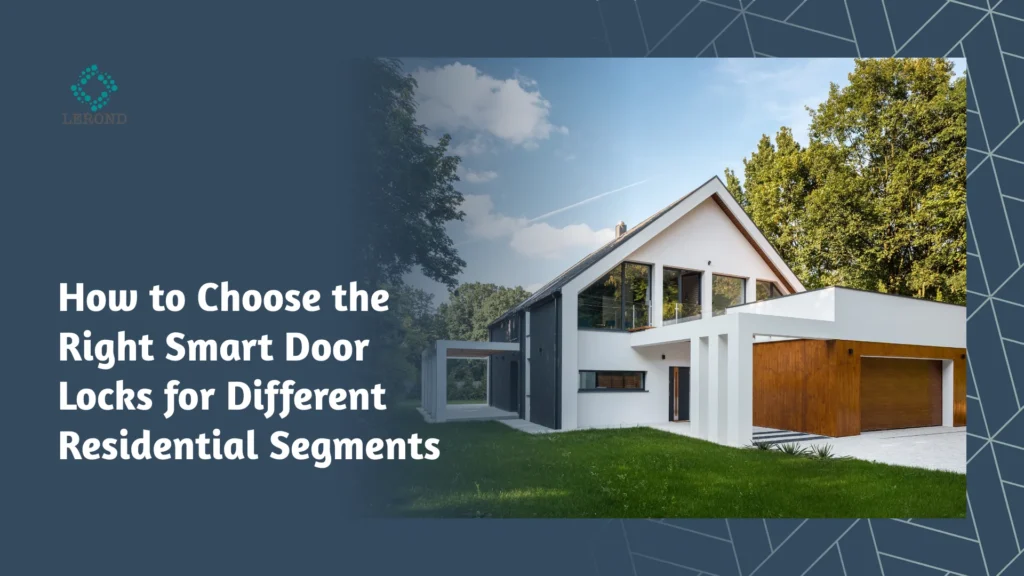
Why Residential Segmentation Matters in Smart Lock Selection
In residential projects, smart lock selection is rarely a one-size-fits-all decision. Villas, high-rise apartments, affordable housing, and detached homes differ significantly in door structure, security expectations, budget allocation, and user behavior. Treating them as a single category often leads to compatibility issues, cost overruns, or mismatched feature sets.
For developers, distributors, and system integrators, the real challenge is not choosing a “good” lock — it is choosing the right smart lock architecture for the right residential segment.
Residential segmentation typically affects smart lock decisions in four major dimensions:
Door Construction & Material
Security Level Requirements
Environmental Exposure
Budget & Standardization Strategy
Understanding how these variables shift across housing types is the foundation of building scalable smart door lock systems for residential applications.
Core Technical Variables That Change by Residential Type
Before analyzing villas versus apartments, it is important to clarify which technical variables actually change when the residential segment changes.
Door Structure & Thickness
Door thickness in residential projects typically ranges between:
35–45 mm (wooden interior doors)
50–70 mm (security doors)
70–100+ mm (armored or reinforced villa entrance doors)
A lock designed for a wooden apartment door cannot be directly installed on an armored villa entrance without modifying spindle length, mortise depth, or fixing structure.
Incorrect door-thickness matching is one of the most common causes of deployment failure in residential projects.
Mortise & Backset Compatibility
Mortise selection becomes increasingly complex as you move from economic housing to high-end villas.
Key variables include:
Mortise body size
Center distance
Backset length
Latch vs. multi-point locking system
Hook bolt vs. straight bolt mechanism
For interior wooden doors in high-rise apartments, a simplified latch mortise may be sufficient.
For armored entrance doors in villas, multi-point locking mechanisms are often required to meet higher anti-forcing standards.
Standardizing mortise specifications across a residential project can significantly reduce after-sales costs and installation errors.
IP Rating & Environmental Exposure
Environmental exposure differs dramatically between residential segments:
Apartment interior doors → IP20 is generally sufficient
Detached house entrance doors → Semi-outdoor exposure
Villa balcony aluminum system doors → Full exposure to rain and dust
Selecting a lock with inadequate IP protection for aluminum balcony doors in villas can result in corrosion, fingerprint module failure, or PCB damage over time.
IP requirements should be evaluated based on actual exposure, not marketing claims.
Access Mode Expectations by Segment
Access preferences shift across residential types:
| Segment | Typical Access Preference |
|---|---|
Villas |
Palm Vein / Face recognition + Fingerprint + PIN + Card + APP |
High-rise apartments |
Face recognition + Fingerprint + PIN + Card + APP |
Economic housing |
PIN + Card + APP |
Detached houses |
Fingerprint + PIN + Card + APP |
Luxury housing buyers often expect multi-factor authentication and full automation.
Affordable housing projects prioritize reliability and cost efficiency.
Understanding access expectations prevents overspecification (which increases cost) or underspecification (which reduces perceived value).
Standardization vs. Customization Strategy
Large-scale housing developments require standardization to control:
Inventory complexity
Installation training
Spare parts management
After-sales servicing
However, villas and high-end detached homes often demand customized lock aesthetics, handle styles, and advanced biometric modules.
Balancing these two strategies is central to selecting scalable smart door locks for residential developments.
Residential Segments Are Security Tiers, Not Just Price Levels
A common mistake is assuming that residential segmentation equals pricing segmentation. In reality, each segment represents a different risk profile and usage model.
Villas → Higher asset value, higher break-in risk, stronger outdoor exposure
High-rise apartments → Controlled building access, lower direct exposure
Economic housing → Budget-driven, but still requiring compliance
Detached houses → Semi-exposed, independent perimeter security
Each tier requires a different balance between:
Mechanical strength
Electronic stability
Weather resistance
Access flexibility
Cost control
In the following sections, we will break down each residential segment and outline the appropriate smart lock configuration logic — including structural compatibility, automation level, and deployment strategy.
Segment-by-Segment Smart Lock Selection Guide
To build scalable smart door lock systems for residential projects, decision-makers must evaluate each housing type independently. Below is a technical breakdown of four common residential segments and the corresponding lock configuration logic.
Technical Comparison Matrix
Before diving into each segment, the following matrix summarizes structural and functional differences:
| Residential Segment | Typical Door Type | Recommended Lock Type | IP Rating | Automation Level | Risk Level |
|---|---|---|---|---|---|
Villas |
Armored entrance + aluminum balcony doors |
Fully automatic multi-point |
IP65–IP67 (balcony) |
High |
High |
High-rise Apartments |
Wooden interior / standard entrance |
Semi-automatic latch |
IP20 |
Medium |
Medium |
Economic Housing |
Standard wooden doors |
Mechanical-hybrid / basic smart |
IP20 |
Low–Medium |
Low |
Detached Houses |
Security doors (semi-outdoor exposure) |
Fully automatic reinforced |
IP54–IP65 |
Medium–High |
High |
This table highlights a key principle: residential segmentation directly impacts mechanical structure, weather resistance, and automation requirements.
Smart Locks for Villas (Luxury Residential Segment)
Villas typically present the most complex deployment scenario due to:
Armored or reinforced entrance doors (70–100mm+ thickness)
Multi-point locking mechanisms
Outdoor exposure (balcony aluminum system doors)
High user expectations for premium access experience
Entrance Doors (Armored / Security Grade)
For villa entrance doors, the lock must support:
Deep mortise body
Multi-point bolt engagement
Strong motor torque output
High-grade anti-forcing structure
Fully automatic locking systems are preferred because they:
Improve user convenience
Reduce latch misalignment
Provide consistent closing feedback
In this segment, developers often select advanced smart door locks with multi-factor authentication (face recognition, fingerprint, PIN, app control).
Security tier is high because villas typically store higher-value assets and lack centralized building access control.
Balcony Aluminum System Doors
This is where many projects fail technically.
Aluminum profile doors (especially slim-frame thermal break systems) require:
Narrow body lock design
Strong anti-corrosion coating
Waterproof biometric module
Sealed PCB structure
An IP20-rated indoor lock is not suitable for semi-outdoor villa balcony doors.
Minimum recommendation: IP65 weather resistance.
Environmental mismatch often leads to fingerprint module failure within 12–24 months.
Smart Locks for High-Rise Apartments
High-rise apartments differ fundamentally from villas:
Controlled building access (lobby + elevator control)
Lower direct environmental exposure
More standardized door dimensions
Interior Wooden Doors
Typical thickness: 35–45mm
Simplified mortise structure
Limited need for multi-point locking
In this segment, semi-automatic latch-based smart door lock systems are typically sufficient.
Over-specifying full automation increases cost without significantly improving security value, since building-level access control already provides a protective layer.
Entrance Doors Within Apartment Units
If the apartment unit uses a reinforced entrance door, IP20 is still sufficient because exposure is indoor.
Selection priorities shift toward:
Stable fingerprint sensor
Low power consumption
Easy maintenance
Standardized backset compatibility
For high-rise residential developments, standardization across hundreds of units becomes critical to minimize installation variability.
Smart Locks for Economic Housing Projects
Affordable housing and budget-driven residential developments require a completely different approach.
Key decision drivers:
Cost control
Simple installation
Low maintenance complexity
Standard mortise compatibility
Fully automatic high-end systems are often unnecessary.
Instead, developers may select simplified smart solutions combining:
PIN access
Card access
Mechanical key backup
For projects targeting cost-sensitive markets, selecting a standardized smart door locks for residential buildings configuration reduces procurement risk and post-installation service costs.
Durability remains important, but biometric module sophistication is usually not a priority.
Smart Locks for Detached Houses
Detached houses differ from villas in scale but share similar exposure characteristics:
Independent perimeter
Semi-outdoor entrance exposure
Higher burglary risk compared to high-rise apartments
Recommended configuration:
Reinforced lock body
IP54–IP65 protection
Fully automatic motor
Remote unlocking capability
Because detached homes lack centralized building control, remote management features (temporary codes, app-based unlock logs) add real value.
In these cases, developers often require scalable solutions from a unified smart door lock provider to ensure consistent firmware support and OTA capability across units.
Cross-Segment Engineering Insight
Across all residential types, three mistakes frequently occur:
Choosing lock aesthetics before structural compatibility
Ignoring IP requirements for semi-outdoor doors
Mixing incompatible mortise types across the same project
Residential smart lock deployment should always begin with:
Door structure audit
Mortise compatibility mapping
Environmental exposure classification
User expectation tiering
Only after these variables are clearly defined should access modes and automation level be finalized.
Engineering-Level Selection Checklist for Residential Projects
Regardless of residential segment, professional deployment of smart door locks should follow a structured engineering checklist. Skipping this stage often results in compatibility issues, warranty claims, or large-scale reinstallation costs.
Below is a practical evaluation framework for developers and distributors.
Door Structure Audit
Before selecting any model, confirm:
Door material (wood, steel, aluminum system, armored composite)
Door thickness range
Backset measurement
Mortise center distance
Existing multi-point locking system (if applicable)
A physical measurement audit should always precede product selection.
For large housing projects, creating a “door structure mapping sheet” significantly reduces deployment risk.
Environmental Classification
Classify every installation position into one of three exposure categories:
Indoor controlled environment (IP20 sufficient)
Semi-outdoor covered entrance (IP54–IP65 recommended)
Direct exposure (rain/dust/high humidity) — IP65+
This step prevents the common mistake of installing indoor-rated locks on aluminum balcony doors in villas or detached homes.
Environmental mismatch is one of the leading causes of early biometric failure.
Access Mode Rationalization
Avoid feature stacking.
Instead, align access modes with residential tier:
Luxury villas → Multi-biometric + app
High-rise apartments → Fingerprint + PIN
Economic housing → PIN + card
Detached houses → Fingerprint + remote access
Over-specification increases procurement cost and maintenance complexity without proportional user value.
Power Supply & Maintenance Planning
Evaluate:
Battery type (lithium vs alkaline)
Emergency power interface
Low-battery alert logic
Replacement cycle
In large-scale residential deployments, battery standardization simplifies maintenance planning and spare part inventory management.
For scalable deployment, selecting integrated smart door lock systems with unified firmware management improves OTA control and long-term support.
Certification & Compliance
Depending on target market:
CE / FCC
Fire door compatibility (if applicable)
Anti-theft grade certification
Local building code requirements
Compliance must be validated at project design stage, not after procurement.
Common Deployment Mistakes in Residential Smart Lock Projects
Even experienced contractors encounter recurring issues.
Mistake 1: Ignoring Mortise Standardization
Mixing multiple mortise types across the same development increases:
Installation training difficulty
Spare part inventory
Service response time
Standardization reduces operational complexity.
Mistake 2: Misjudging IP Requirements
Installing IP20 locks on semi-exposed doors leads to:
Fingerprint corrosion
Water ingress on PCB
Premature motor failure
Environmental exposure must be assessed based on real-world conditions, not door location labels.
Mistake 3: Selecting Based on Aesthetics First
Handle design and color are secondary to:
Structural compatibility
Mechanical strength
Installation tolerance
Engineering fit should always precede visual preference.
Mistake 4: Underestimating After-Sales Scalability
For residential developments with hundreds of units, selecting a fragmented supplier network complicates firmware updates and spare part sourcing.
Working with a unified smart door lock systems provider ensures:
Consistent firmware version control
Centralized technical documentation
Standardized spare parts ecosystem
FAQ for Residential Smart Lock Selection
What IP rating is required for villa entrance and balcony doors?
Villa entrance doors may operate under semi-outdoor exposure depending on canopy design. For aluminum balcony doors or entrances exposed to rain and dust, IP65 or above is recommended. IP20 indoor-rated locks should not be installed in exposed areas, as moisture can damage biometric modules and internal PCBs over time.
Can the same smart lock model be used across all residential segments?
In most cases, no. Door thickness, mortise type, and environmental exposure differ significantly between villas, apartments, and economic housing. While firmware platforms may be unified, mechanical structure often needs to vary to ensure proper compatibility and security level.
Are fully automatic locks necessary for apartments?
Not necessarily. In high-rise apartments with centralized building access control, semi-automatic latch-based systems are often sufficient. Fully automatic systems add convenience but may not significantly increase security value in controlled-access buildings.
How does mortise selection differ between armored and wooden doors?
Armored doors typically require deeper mortise bodies and multi-point locking mechanisms. Wooden interior doors use simplified latch mortise systems. Incorrect mortise selection can cause misalignment, installation failure, or long-term mechanical wear.
What access modes are preferred in luxury villas?
Luxury villas commonly demand multi-factor authentication such as face recognition, fingerprint, PIN, and mobile app control. High-end buyers prioritize convenience and technological sophistication alongside security.
How can developers balance cost and security in economic housing?
By standardizing a simplified configuration that includes reliable PIN and card access with mechanical backup. Avoid overloading features that increase cost without measurable security benefits. Structural compatibility and durability should remain primary priorities.
What certifications are important for residential smart locks?
Common certifications include CE and FCC for electronics compliance. Depending on region, fire resistance compatibility and anti-theft grading may also be required. Always verify regulatory requirements before large-scale procurement.
How can lock selection be standardized across large housing developments?
Start with a door structure audit across all units. Identify thickness range, mortise type, and exposure conditions. Then define 1–2 standardized lock configurations that meet most scenarios. Avoid mixing multiple incompatible structural platforms.
Final Decision Framework
Choosing the right lock for residential projects is not about selecting the most advanced product — it is about matching:
Door structure
Exposure level
Security tier
Budget range
Maintenance capability
A structured approach ensures that smart door locks are deployed as scalable infrastructure rather than isolated hardware components.
Project Consultation
Planning a residential housing development or distributing smart locks for villas and apartments?
Explore LEROND smart door lock systems portfolio or contact our engineering team for a compatibility assessment tailored to your residential segment.
Selecting the correct configuration at the design stage can reduce installation risk, improve long-term reliability, and protect your project margins.
high-traffic commercial. Full OEM/ODM technical support.