Understanding Smart Lock Automation Types
Modern smart door locks have evolved far beyond traditional mechanical locks. Instead of relying solely on keys and manual operation, today’s systems integrate electronic authentication, motorized locking mechanisms, and smart access control technologies.
However, not all smart locks operate in the same way. One of the most important distinctions in the industry is the difference between fully automatic smart door locks and semi-automatic smart door locks.
At first glance, these two types may appear similar because both support modern unlocking methods such as fingerprint recognition, PIN codes, RFID cards, or mobile apps. The real difference lies in how the lock mechanically retracts and extends the locking bolt.
The internal drive structure determines whether the lock performs the entire unlocking process automatically or requires a mechanical action from the user.
In general:
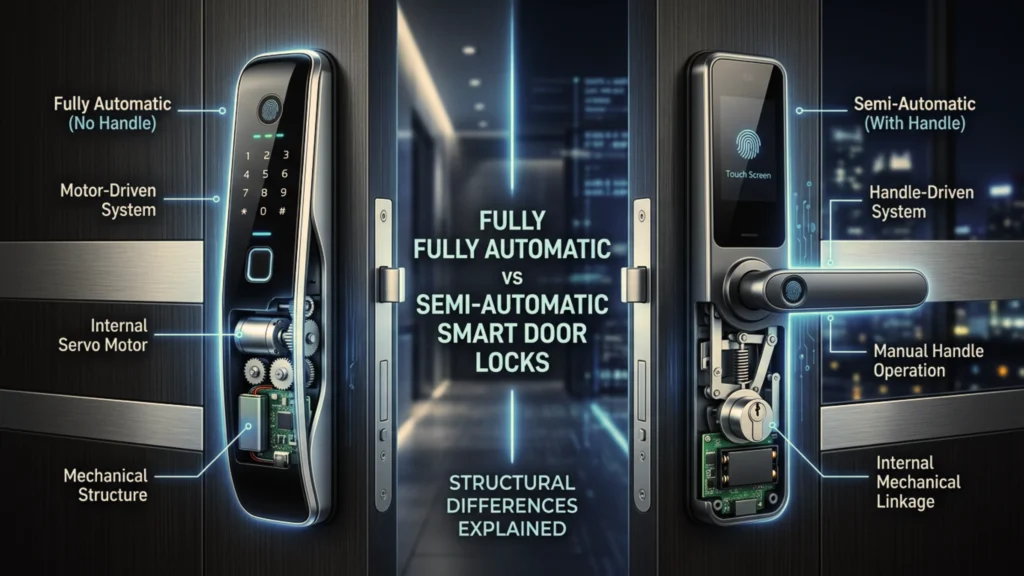
Fully automatic smart door locks use a motor-driven system to retract and extend the deadbolt automatically.
Semi-automatic smart door locks rely on a motor-assisted clutch mechanism but still require the user to press the handle to complete the unlocking movement.
This difference affects several key aspects of lock design, including:
mechanical complexity
motor load and power consumption
user experience
installation compatibility with different door types
Understanding these structural differences is essential for system integrators, property developers, and security professionals evaluating modern smart door lock systems for residential or commercial applications.
For a broader overview of system architecture, access technologies, and deployment scenarios, you can also explore our complete guide to smart door lock systems.
What Is a Fully Automatic Smart Door Lock
A fully automatic smart door lock is designed to perform the entire locking and unlocking process through an internal motorized mechanism. Once authentication is successful, the lock automatically retracts the bolt without requiring any manual handle operation.
This design focuses on maximum automation and convenience.
How Fully Automatic Smart Locks Operate
The typical operation sequence of a fully automatic lock is:
User authentication (fingerprint, password, card, or mobile app)
Control board verifies credentials
Internal motor activates
Gear transmission retracts the deadbolt
Door opens without handle action
When the door closes, the system may also trigger automatic locking, extending the bolt again using the motorized drive system.
This fully motorized process is why these products are often referred to as automatic smart locks or motorized deadbolt smart locks.
Key Internal Components
Inside a fully automatic smart door lock, several mechanical and electronic components work together:
Micro DC Motor
A compact electric motor provides the torque required to move the locking bolt.
Reduction Gearbox
The gearbox converts the motor’s high speed into controlled torque suitable for driving the bolt mechanism.
Motorized Deadbolt Drive
A transmission structure connects the gearbox to the deadbolt or latch, allowing the motor to retract and extend it.
Position Sensors
Sensors monitor the bolt position to ensure accurate locking and unlocking operations.
Electronic Control Board
This board processes authentication signals and manages the motor control system.
Because the motor performs the entire movement of the bolt, fully automatic smart door locks generally provide a smoother and more seamless user experience. Users simply authenticate, and the door unlocks automatically.
This design is particularly common in:
high-end residential entrance doors
smart home integrated access systems
premium apartment developments
These environments prioritize touchless access and automation, which makes motorized unlocking highly attractive.
However, the reliance on a full motor drive system also introduces certain engineering considerations, such as motor durability, power consumption, and gearbox lifespan. These factors are important when evaluating the long-term reliability of modern smart door locks used in high-frequency access environments.
What Is a Semi-Automatic Smart Door Lock
A semi-automatic smart door lock uses a different mechanical philosophy. Instead of allowing the motor to move the entire bolt, the system only releases a locking mechanism internally. The actual bolt retraction is completed through the door handle movement.
In other words, the electronic system unlocks the lock internally, but the user still needs to press the handle to open the door.
How Semi-Automatic Smart Locks Work
The typical unlocking sequence is:
User authentication (fingerprint, PIN, card, etc.)
Control board verifies the credential
Motor activates a clutch mechanism
Handle becomes mechanically connected to the latch system
User presses the handle to retract the bolt
This design is often referred to as a motorized clutch smart lock mechanism.
Instead of forcing the motor to move the entire bolt assembly, the motor simply engages or disengages the clutch, allowing the handle to operate the latch mechanism.
Key Structural Components
Inside a semi-automatic smart door lock, the internal mechanism typically includes:
Micro Motor with Clutch System
A small motor activates the clutch to release the locking state.
Mechanical Handle Transmission
The handle is mechanically linked to the latch mechanism once the clutch engages.
Latch or Deadbolt Assembly
The latch retracts when the user presses the handle.
Electronic Control Board
Responsible for authentication verification and clutch activation.
Because the motor does not directly move the bolt, the mechanical load on the motor is significantly reduced. This design often results in:
lower power consumption
simpler internal structure
longer motor lifespan
Semi-automatic smart locks are therefore widely used in doors where mechanical leverage from the handle is preferred, such as:
aluminum profile doors
interior residential doors
commercial access doors
These environments benefit from the balance between electronic security and mechanical simplicity, which is why many widely deployed smart door lock systems still rely on semi-automatic designs.
Internal Mechanism Comparison
Although fully automatic smart door locks and semi-automatic smart door locks may look similar externally, their internal mechanical architecture differs significantly. These differences affect how the locking bolt moves, how much load is placed on the motor, and how the system behaves during daily use.
In most modern smart door locks, the internal structure consists of three core subsystems:
Authentication and control system – fingerprint module, keypad, RFID reader, or mobile connectivity
Electronic control board – processes credentials and manages the locking mechanism
Mechanical drive system – the components that physically move the bolt or latch
The third subsystem—the mechanical drive system—is where the major difference between fully automatic and semi-automatic designs lies.
Fully automatic smart locks rely on a motor-driven bolt system, while semi-automatic locks typically rely on a motor-controlled clutch combined with a mechanical handle drive.
Understanding this distinction is essential when evaluating modern smart door locks for reliability, power efficiency, and long-term durability.
How Fully Automatic Smart Locks Work
A fully automatic smart door lock uses an electric motor as the primary source of movement for the locking bolt. After authentication is verified, the motor directly drives the bolt mechanism through a gear transmission system.
The entire unlocking action is therefore performed electronically.
Motorized Drive Sequence
The typical sequence inside a fully automatic lock is:
User authentication (fingerprint, PIN code, card, or mobile app)
Control board sends a signal to the motor driver
Micro DC motor activates
Gear reduction system converts motor speed into torque
Deadbolt retracts automatically
Because the motor physically retracts the bolt, the door can be opened immediately after authentication without pressing a handle.
Many systems also support automatic locking, meaning the bolt extends again when the door is closed. Sensors inside the lock detect door position and trigger the motor to extend the bolt.
Core Mechanical Components
Inside a fully automatic lock, the following components are typically present:
Micro DC Motor
Provides rotational force for the bolt movement.
Gear Reduction Mechanism
Converts high-speed motor rotation into the torque required to move the bolt.
Deadbolt Drive Linkage
Transfers the motor’s movement to the locking bolt.
Position Sensors
Monitor the bolt status to ensure accurate locking and unlocking.
Because the motor must handle the entire mechanical movement, fully automatic locks require careful engineering in areas such as:
motor torque design
gear durability
battery efficiency
These engineering considerations are critical in high-traffic environments where smart door lock systems may perform thousands of locking cycles per year.
How Semi-Automatic Smart Locks Work
A semi-automatic smart door lock follows a different mechanical philosophy. Instead of allowing the motor to move the bolt directly, the motor only releases or engages a clutch mechanism inside the lock.
The actual bolt movement is completed by the user pressing the handle.
Clutch-Assisted Unlocking Process
The unlocking process usually follows this sequence:
User authentication is verified
Control board activates the motor
Motor engages or disengages the clutch
Handle becomes connected to the latch mechanism
User presses the handle to retract the latch or bolt
In this design, the motor does not need to move the heavy locking bolt. Instead, it simply enables the handle to transmit mechanical force to the latch system.
Key Mechanical Components
A typical semi-automatic smart lock includes:
Micro Motor
Used to control the clutch engagement.
Clutch Mechanism
Connects or disconnects the handle from the locking mechanism.
Handle Transmission Assembly
Transfers the mechanical force of the handle movement to the latch.
Latch or Deadbolt System
Retracts when the handle rotates downward.
Because the motor performs only a small movement to activate the clutch, semi-automatic locks often achieve:
lower energy consumption
reduced motor wear
simpler mechanical design
For this reason, semi-automatic mechanisms are widely used in doors where manual handle operation is natural, such as aluminum frame doors, interior doors, or commercial office access points.
Many large-scale building projects still adopt semi-automatic mechanisms because they balance electronic security with mechanical reliability, especially when integrated into advanced smart door lock systems deployed across multiple access points.
Fully Automatic vs Semi-Automatic Smart Lock Comparison
To better understand the practical differences between these two technologies, the following table summarizes the main structural and functional distinctions.
| Feature | Fully Automatic Smart Door Lock | Semi-Automatic Smart Door Lock |
|---|---|---|
Bolt movement |
Motor retracts and extends the bolt |
Handle retracts bolt after clutch release |
Unlocking action |
Fully automatic after authentication |
Requires handle press |
Internal drive system |
Motorized bolt drive |
Motorized clutch + mechanical handle |
Motor workload |
High (moves entire bolt) |
Low (controls clutch only) |
Power consumption |
Higher |
Lower |
Mechanical complexity |
More electronic components |
Simpler mechanical structure |
User experience |
Seamless and fully automatic |
Partially manual |
Installation compatibility |
Often used for entrance doors |
Compatible with more door structures |
Typical applications |
Smart homes, premium residential |
Interior doors, aluminum doors, offices |
From an engineering perspective, neither design is universally better. Instead, each system is optimized for different priorities.
Fully automatic locks prioritize automation and convenience, while semi-automatic locks prioritize mechanical simplicity and efficiency.
Understanding these structural differences helps system integrators choose the appropriate solution when designing secure and scalable smart door lock systems for residential, commercial, or mixed-use developments.
Advantages and Limitations of Each System
Both fully automatic smart door locks and semi-automatic smart door locks offer modern access control capabilities, but their mechanical architecture leads to different advantages in real-world applications.
Understanding these strengths and limitations helps integrators, property developers, and security planners select the right solution when deploying modern smart door locks across different door types.
Advantages of Fully Automatic Smart Locks
The biggest advantage of a fully automatic smart door lock is the seamless user experience it provides.
Because the internal motor directly retracts the bolt, the door unlocks immediately after authentication. Users do not need to press a handle or apply any mechanical force.
This provides several practical benefits:
1. True Hands-Free Operation
Users simply authenticate with fingerprint, PIN code, card, or mobile app, and the lock automatically opens. This is especially convenient when carrying items or accessing doors frequently.
2. Automatic Locking Capability
Many fully automatic locks automatically extend the bolt once the door closes. This reduces the risk of doors being accidentally left unlocked.
3. Better Smart Home Integration
Fully automatic locking systems integrate more naturally with smart home platforms, allowing automation such as:
auto-lock when the door closes
remote unlock via mobile app
access logging and monitoring
Because of these advantages, fully automatic mechanisms are often used in high-end residential properties and integrated smart door lock systems designed for modern smart homes.
However, the higher level of automation also introduces additional engineering complexity. The motor must handle the full bolt movement, which increases:
power consumption
internal component stress
mechanical design requirements
These factors can increase production cost compared with semi-automatic systems.
Advantages of Semi-Automatic Smart Locks
A semi-automatic smart door lock focuses on mechanical simplicity and efficiency.
Instead of forcing the motor to move the bolt directly, the system only releases the clutch, allowing the user to retract the latch by pressing the handle.
This design provides several advantages.
1. Lower Power Consumption
Because the motor only activates the clutch, the energy demand is significantly lower than in fully motorized systems. This often results in longer battery life.
2. Reduced Motor Wear
Since the motor does not need to move the entire bolt, the internal motor experiences less mechanical load. This can improve long-term durability.
3. Wider Door Compatibility
Semi-automatic mechanisms work particularly well with door types that already rely on mechanical handle operation, such as:
aluminum profile doors
interior wooden doors
commercial office doors
For many projects, this balance between electronic authentication and mechanical operation provides a reliable and cost-effective solution within larger smart door lock systems.
However, semi-automatic designs also have some limitations.
Because users must press the handle after authentication, the experience is slightly less seamless than with fully automatic locks. In high-end residential projects where automation is a priority, developers often prefer fully motorized systems.
Which Smart Lock Type Should You Choose
Choosing between fully automatic smart door locks and semi-automatic smart door locks depends largely on the door structure, user experience requirements, and project budget.
Rather than viewing one system as superior, it is better to evaluate which mechanism aligns with the specific application environment.
Best Applications for Fully Automatic Smart Locks
Fully automatic smart locks are typically preferred in environments where convenience and automation are key priorities.
Common scenarios include:
Residential Entrance Doors
Luxury apartments and modern houses often use fully automatic locks to provide a premium access experience.
Smart Home Integration
Homes equipped with integrated automation platforms benefit from motorized locking systems that can interact with other devices.
Short-Term Rental Properties
Vacation rentals and serviced apartments often rely on automated locking to simplify guest access management.
Because these applications prioritize convenience and automation, fully motorized locks are frequently used in advanced smart door lock systems designed for modern residential
Best Applications for Semi-Automatic Smart Locks
Semi-automatic locks are widely used in projects where reliability, cost efficiency, and door compatibility are the main priorities.
Typical scenarios include:
Aluminum Frame Doors
Many aluminum doors use mechanical handle structures that naturally pair with clutch-based locking systems.
Interior Residential Doors
Bedrooms, offices, and internal access points often use semi-automatic locks where full automation is unnecessary.
Commercial Access Doors
Office buildings frequently adopt semi-automatic locks because they provide reliable electronic authentication while maintaining simple mechanical operation.
These characteristics make semi-automatic locks a practical choice in many large-scale deployments of smart door locks.
How Automation Type Impacts Smart Lock System Design
The automation mechanism of a smart lock also affects the broader architecture of smart door lock systems.
System designers must consider several engineering factors when selecting between fully automatic and semi-automatic mechanisms.
Motor Torque Requirements
Fully automatic locks require motors capable of generating enough torque to move the deadbolt reliably under varying door conditions.
Semi-automatic locks require much smaller motors because the handle provides the mechanical force needed to retract the bolt.
Battery Consumption
Motor-driven bolt systems consume more energy per locking cycle, which can reduce battery life if not carefully optimized.
Clutch-based systems generally consume less energy, making them suitable for installations where maintenance access is limited.
Mechanical Wear
Fully automatic locks distribute mechanical stress across the motor, gearbox, and transmission system.
Semi-automatic locks shift more of the mechanical movement to the handle mechanism, which can reduce motor fatigue but increase handle usage cycles.
For engineers designing large-scale access control deployments, understanding these trade-offs is essential when building reliable and scalable smart door lock systems.
FAQ – Fully Automatic vs Semi-Automatic Smart Locks
Are fully automatic smart locks more reliable?
Not necessarily. Reliability depends on overall engineering quality rather than automation type. Fully automatic locks rely more heavily on motors and gear systems, which must be carefully designed to handle repeated cycles. Semi-automatic locks place less stress on the motor but rely on mechanical handle operation. Both systems can achieve high reliability when properly engineered.
Do semi-automatic smart locks consume less battery power?
Yes, in most cases they do. Semi-automatic locks only use the motor to activate a clutch mechanism, which requires significantly less energy than moving the entire bolt assembly. Fully automatic locks consume more power because the motor must retract and extend the bolt during each locking cycle.
Why do some smart locks require pressing the handle?
This is typical of semi-automatic smart locks. After authentication, the motor releases the clutch so the handle can mechanically retract the latch. Pressing the handle completes the unlocking process.
Are fully automatic smart locks safer?
Both systems can offer high levels of security when built with strong locking mechanisms and secure authentication technologies. Security depends more on lock design, materials, and access control features than on whether the system is fully automatic or semi-automatic.
Can semi-automatic smart locks support auto-locking?
Yes. Many semi-automatic smart locks support automatic locking when the door closes. The difference is that unlocking still requires handle operation.
Which type is better for aluminum doors?
Semi-automatic smart locks are often better suited for aluminum frame doors because these doors typically rely on handle-based latch mechanisms. The clutch system integrates naturally with this structure.
Do fully automatic smart locks still work during battery failure?
Most smart locks include emergency solutions such as mechanical keys or external power ports. These backup systems ensure access even if the main battery is depleted.
Are fully automatic smart locks becoming the industry standard?
Fully automatic locks are increasingly popular in high-end residential markets, especially in smart home environments. However, semi-automatic locks remain widely used because of their reliability, efficiency, and compatibility with many door structures.
Explore Modern Smart Door Lock Systems
Whether you are evaluating fully automatic or semi-automatic mechanisms, understanding the internal structure of smart locks is essential for choosing the right solution for your project.
To learn more about architecture, technologies, and deployment strategies, explore LEROND smart door lock systems and discover how modern smart door locks are transforming residential and commercial access control.
high-traffic commercial. Full OEM/ODM technical support.