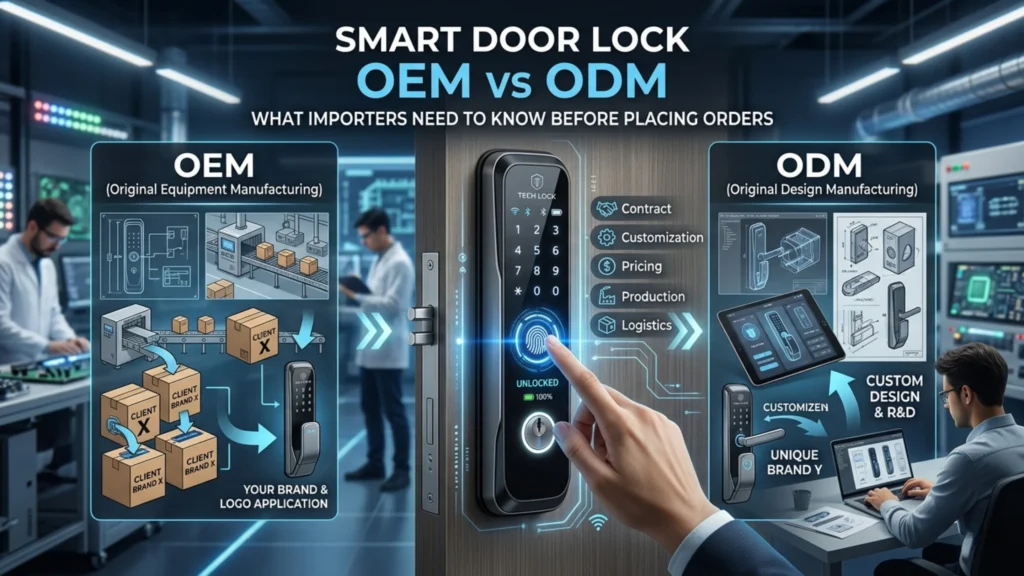
Understanding OEM and ODM in the Smart Door Lock Industry
As global demand for smart door locks continues to grow across residential, hospitality, and commercial markets, more importers and distributors are looking for manufacturing partners to build their product lines. However, one of the first strategic decisions buyers must make is whether to work with a smart door lock manufacturer under an OEM or ODM model.
While these terms are widely used in the electronics and smart home industries, many new importers misunderstand their implications. Choosing the wrong model can affect product differentiation, development cost, lead time, and even long-term brand strategy.
For companies planning to build a scalable smart access product portfolio, understanding the manufacturing structure behind modern smart door lock systems is essential before placing large production orders.
What Does OEM Mean for Smart Door Locks
OEM stands for Original Equipment Manufacturer. In the smart lock industry, OEM manufacturing typically means that the buyer provides the product concept, specifications, or design requirements, while the manufacturer handles engineering validation, production, and assembly.
Under an OEM model, the importer usually controls key elements of the product, such as:
Industrial design and appearance
Hardware architecture (motor type, sensor modules, chipset)
Firmware features and system integration
Mobile application ecosystem
Branding and packaging
In practical terms, this means the buyer is building a unique smart lock product that is not widely available in the open market.
For example, a distributor may request a custom fingerprint module, specific motor torque for heavy doors, or integration with a proprietary smart home platform. The manufacturer then develops the hardware and firmware according to these requirements before mass production begins.
OEM projects typically involve several stages:
Product specification definition
Engineering validation and prototype development
Firmware testing and optimization
Certification preparation
Mass production
Because of this process, OEM smart lock projects usually require higher investment and longer development cycles. However, they also offer a critical advantage for established brands: product differentiation.
Experienced distributors often prefer OEM when they want to build a competitive product ecosystem rather than sell generic smart locks available to multiple importers.
For buyers still evaluating the architecture and technology stack behind modern smart door locks, understanding the broader design structure of smart door lock systems can help clarify which elements can realistically be customized within an OEM project.
What Does ODM Mean in Smart Lock Manufacturing
ODM stands for Original Design Manufacturer. In this model, the manufacturer already owns the product design, engineering structure, and firmware platform. Importers simply purchase the product and apply their own branding.
In other words, the factory develops the smart lock, while the buyer focuses primarily on distribution and marketing.
ODM manufacturing is extremely common in the smart home industry because it allows new brands to launch products much faster. Instead of investing in product development, buyers select from an existing catalog of smart lock models and request minor customization such as:
Brand logo engraving
Packaging design
Mobile app branding
Language localization
Small firmware adjustments
Because the core hardware and firmware already exist, ODM projects dramatically reduce development time. A private label smart lock can often move from sample approval to mass production in just a few weeks.
For many small importers or regional distributors, this model offers a practical way to enter the market without large upfront investment.
However, the trade-off is limited product exclusivity. Since the design belongs to the manufacturer, similar products may also be supplied to other distributors in different regions.
For companies that want to move quickly into the smart access market but are not yet ready to invest in product engineering, ODM provides a balanced starting point.
Why the OEM vs ODM Decision Matters for Importers
The choice between OEM and ODM is not simply a manufacturing detail. It directly influences how an importer builds their product strategy.
In large-scale procurement, the decision affects several key factors:
Product differentiation
OEM projects enable unique features and proprietary design elements, while ODM models typically rely on standardized products.
Investment level
OEM requires engineering resources, prototype testing, and development costs. ODM significantly lowers initial investment.
Speed to market
ODM products can be launched quickly, while OEM development cycles may take several months.
Long-term competitiveness
Brands seeking to build strong positioning in the smart home ecosystem often transition toward OEM as their product portfolio expands.
For companies planning to operate in the smart access industry long term, understanding the engineering and system architecture behind smart door locks is critical when deciding which model aligns with their growth strategy.
Importers evaluating suppliers should therefore not only compare pricing but also understand how modern smart door lock systems are designed, produced, and integrated into larger smart home environments.
OEM vs ODM Smart Door Locks: Key Differences for B2B Buyers
For importers sourcing smart door locks from international manufacturers, understanding the operational differences between OEM and ODM production is critical. While both models allow buyers to launch branded products, the level of control, investment, and customization varies significantly.
In practice, the decision affects not only product design but also long-term competitiveness in the smart access market.
The following comparison highlights the most important factors buyers should evaluate before placing large-volume orders.
OEM vs ODM Smart Door Locks: Comparison Table
| Factor | OEM Smart Door Locks | ODM Smart Door Locks |
|---|---|---|
Product Design Ownership |
Buyer owns design and specifications |
Manufacturer owns the design |
Development Investment |
Higher (engineering & tooling costs) |
Lower (existing product platform) |
Customization Level |
Full hardware and firmware customization |
Limited customization |
Product Exclusivity |
High – unique product for the buyer |
Medium – similar products may exist |
Time to Market |
Longer development cycle |
Faster product launch |
MOQ Requirements |
Usually higher |
Often lower |
Brand Differentiation |
Strong |
Moderate |
Engineering Control |
Buyer-driven |
Manufacturer-driven |
For experienced distributors, this table summarizes the strategic trade-off between speed and differentiation.
Companies aiming to build a strong brand in the smart home ecosystem often choose OEM. Meanwhile, importers entering the market for the first time frequently start with ODM to test demand.
Understanding how modern smart door lock systems are engineered also helps buyers determine which components are realistically customizable within each model.
Cost Structure Comparison
One of the most common misconceptions among new importers is that OEM manufacturing simply means placing a bulk order with a factory. In reality, OEM projects typically involve additional development investment.
These costs may include:
NRE (Non-Recurring Engineering) fees
Engineering teams must adapt or redesign hardware structures such as fingerprint modules, motor drivers, or PCB layouts.
Tooling and mold development
If a unique industrial design is required, new molds for lock housings or mechanical components may be necessary.
Firmware development
Custom smart lock firmware may need to support specific communication protocols, mobile apps, or smart home ecosystems.
Testing and certification preparation
OEM products may require additional verification testing before entering international markets.
Because of these development requirements, OEM projects generally involve higher upfront cost compared to ODM sourcing.
However, the long-term advantage is product exclusivity. For brands competing in mature markets, a differentiated product architecture can provide significant competitive protection.
Importers evaluating OEM proposals often review how the manufacturer designs the internal architecture of smart door locks, including motor systems, biometric modules, wireless connectivity, and power management.
Customization Capabilities
Customization is one of the most decisive factors when choosing between OEM and ODM smart lock manufacturing.
In an OEM project, buyers may request deep-level customization across multiple technical layers.
Examples include:
Hardware configuration
Custom fingerprint recognition modules
Higher torque motors for heavy security doors
Alternative wireless communication modules (WiFi, Zigbee, Bluetooth)
Mechanical structure
Lock body compatibility for regional door standards
Reinforced metal housing for outdoor environments
Custom handle or keypad designs
Firmware and system integration
Integration with proprietary mobile apps
Smart home platform compatibility
Remote management platforms for property management
This level of customization allows brands to create a truly differentiated product.
By contrast, ODM products typically allow more limited modifications. Importers can still adjust visual and branding elements, but the underlying hardware and firmware architecture usually remain unchanged.
Typical ODM customization options include:
Logo engraving or laser marking
Packaging design
Mobile app branding
Language localization
Minor firmware adjustments
While ODM customization is more limited, it still provides enough flexibility for many distributors to establish a recognizable private label product line.
For buyers new to the industry, reviewing the architecture behind modern smart door lock systems can help clarify which features are fundamental hardware components and which can be modified through firmware.
Lead Time and Production Considerations
Another major factor in the OEM vs ODM decision is time to market.
OEM projects typically require a longer development timeline because the product must go through engineering validation before production.
A typical OEM development process may include:
Product concept confirmation
Mechanical and electronic design
Prototype development
Functional testing and firmware optimization
Certification preparation
Mass production
Depending on the complexity of the product, this process can take several months before the first commercial shipment.
ODM products, on the other hand, already exist as finished designs. As a result, the sourcing process is significantly faster.
Importers can typically move through the following steps:
Product selection from manufacturer catalog
Sample evaluation
Branding customization
Packaging approval
Mass production
Because the engineering phase is already complete, ODM orders can often reach production within weeks rather than months.
For many importers, this speed advantage makes ODM an effective strategy for launching their first smart door locks while evaluating market demand.
As their brand grows and distribution channels expand, companies often transition toward OEM development to create proprietary products and build stronger differentiation in the global smart access market.
When Should Importers Choose OEM Smart Door Locks
While ODM manufacturing is often the fastest entry point into the smart lock market, many established brands eventually move toward OEM development to strengthen product differentiation and long-term competitiveness.
OEM smart lock manufacturing is particularly suitable for companies that want greater control over product architecture, functionality, and ecosystem compatibility.
Building a Unique Smart Lock Product Line
One of the main motivations behind OEM projects is the ability to create a distinct product portfolio. In competitive markets where multiple distributors may offer similar products, having a differentiated design becomes a strategic advantage.
Through OEM development, importers can define key product characteristics such as:
Biometric authentication technology
Lock motor configuration and torque performance
User interface design
Connectivity options such as Wi-Fi, Bluetooth, or Zigbee
Integration with specific smart home ecosystems
These elements shape how smart door locks perform in real-world installations, especially across different door types and environmental conditions.
Understanding the technical structure behind smart door lock systems is therefore essential when defining OEM product specifications.
Integrating Smart Locks Into Smart Home Ecosystems
Another reason importers choose OEM is the need for deeper integration with smart home platforms.
For example, property developers, smart home solution providers, or security system integrators may require smart locks that can communicate directly with their ecosystem through specific communication protocols.
OEM development allows manufacturers to adapt firmware, communication modules, and software interfaces to meet these requirements.
This level of customization is rarely possible with standard ODM products.
Companies building larger smart home product portfolios often treat smart door locks as one component within a broader connected ecosystem that may include sensors, gateways, and automation systems.
In these scenarios, understanding the architecture of smart door lock systems becomes essential when coordinating device interoperability and access control features.
Long-Term Brand Strategy
From a strategic perspective, OEM manufacturing allows brands to gradually build proprietary products rather than relying on widely distributed designs.
This is particularly important in regions where multiple distributors source from the same group of ODM manufacturers. Without differentiation, competing primarily on price can quickly erode margins.
By investing in OEM development, companies can:
Protect product design exclusivity
Build stronger brand identity
Improve compatibility with smart home ecosystems
Develop long-term supplier partnerships
For distributors planning to scale their presence in the smart access market, OEM development often becomes the next step after gaining experience with ODM sourcing.
When ODM Smart Door Locks Are the Better Choice
Despite the advantages of OEM, ODM manufacturing remains the preferred option for many importers, particularly during early market entry.
ODM allows companies to launch products quickly while minimizing development risk.
Faster Time to Market
Speed is one of the most important benefits of ODM sourcing.
Because the manufacturer already owns the design and engineering platform, importers can bypass the entire product development stage. After selecting a model, the buyer typically only needs to approve samples and finalize branding.
This makes it possible to introduce new smart door locks into the market within a much shorter timeframe.
For distributors operating in fast-growing smart home markets, this speed advantage can be critical for capturing early demand.
Lower Initial Investment
Another major advantage of ODM is the lower financial barrier.
OEM development often involves engineering resources, testing procedures, and tooling investment. For companies entering the industry for the first time, this level of commitment may not be necessary.
ODM sourcing allows importers to evaluate product demand before investing in deeper customization.
Many successful distributors initially launch ODM products, build market knowledge, and later transition toward OEM manufacturing once sales volume increases.
Testing Market Demand
ODM products also allow buyers to test different product categories with minimal risk.
For example, distributors may evaluate demand across several smart lock segments, including:
Apartment door smart locks
Interior door smart locks
Outdoor gate locks
Commercial access control locks
Once market demand becomes clearer, importers can then decide whether it is worthwhile to develop customized smart door lock systems under an OEM model.
How to Choose the Right Smart Lock Manufacturer
Regardless of whether buyers choose OEM or ODM, selecting the right manufacturing partner is critical for long-term success.
Experienced importers typically evaluate several factors before establishing supplier relationships.
Evaluate R&D Capability
Smart locks combine mechanical engineering, electronics, firmware development, and wireless communication technologies.
A capable manufacturer should therefore maintain dedicated engineering teams capable of developing and optimizing smart door locks across multiple technical disciplines.
Key indicators include:
Hardware engineering expertise
Firmware development capability
Mobile application integration
Smart home platform compatibility
Manufacturers with strong R&D resources are better positioned to support OEM development and product evolution over time.
Check Certification and Compliance
International markets often require certification to ensure product safety and wireless compliance.
Depending on the destination market, importers may need products certified under standards such as:
CE certification
FCC certification
RoHS compliance
Manufacturers experienced in exporting smart door lock systems should be familiar with the certification processes required for different regions.
Understand Production Capacity
Production capacity becomes especially important once orders begin scaling.
Importers should verify:
Monthly production capacity
Supply chain stability for critical components
Quality control procedures during assembly
Reliable production capacity ensures that distributors can meet market demand without experiencing supply disruptions.
Quality Control and Testing
Smart locks must operate reliably under daily use, which means quality control procedures are essential.
Manufacturers typically perform multiple tests during production, including:
Mechanical durability testing
Electronic function testing
Communication stability testing
Environmental testing for temperature and humidity
These processes help ensure that smart door locks maintain consistent performance after installation.
Smart Door Lock OEM / ODM Decision Framework
For importers comparing manufacturing models, the following framework can simplify the decision process.
| Business Situation | Recommended Model |
|---|---|
New brand entering the market |
ODM |
Small or regional distributor |
ODM |
Established smart home brand |
OEM |
Property developer ecosystem integration |
OEM |
Testing market demand |
ODM |
Long-term brand differentiation |
OEM |
Many companies begin with ODM sourcing before gradually transitioning toward OEM development as their product portfolio and market presence grow.
Understanding the engineering foundations of smart door lock systems can help buyers determine which elements should remain standardized and which are worth customizing for competitive advantage.
FAQ – Smart Door Lock OEM and ODM Manufacturing
What is the typical MOQ for OEM smart door locks?
Minimum order quantities for OEM projects usually depend on the level of customization required. When a product involves new tooling, firmware development, or mechanical redesign, manufacturers typically require higher order volumes to offset development costs. For many smart lock factories, OEM MOQ ranges from several hundred to several thousand units depending on the project scope. Importers should discuss expected annual volume with manufacturers early in the negotiation process.
Can importers customize firmware in OEM smart lock projects?
Yes. Firmware customization is one of the most common reasons companies choose OEM manufacturing. Importers may request changes such as mobile app integration, access management logic, communication protocol adjustments, or compatibility with smart home ecosystems. However, the complexity of firmware development depends on the existing hardware architecture and wireless modules used in the product.
How long does OEM smart lock development usually take?
Development timelines vary depending on product complexity. Simple OEM modifications may take a few weeks, while full hardware redesign projects can take several months. The development cycle generally includes prototype creation, engineering validation, testing, and certification preparation before mass production can begin.
Is ODM suitable for private label smart lock brands?
Yes. ODM manufacturing is widely used by private label brands entering the smart home market. It allows distributors to launch branded products quickly without investing heavily in product engineering. Many importers start with ODM sourcing to build distribution channels before moving into OEM development.
What certifications are required for exporting smart door locks?
Certification requirements depend on the target market. For example, products sold in Europe may require CE compliance, while the United States typically requires FCC certification for wireless devices. Importers should confirm certification requirements in their destination market before placing large production orders.
Can ODM smart locks still be partially customized?
Yes. Although ODM products use an existing design platform, many manufacturers allow limited customization. Importers may request brand logos, packaging design, language localization, and sometimes minor firmware adjustments. However, core hardware architecture typically remains unchanged.
How can importers protect product designs in OEM projects?
Design protection can be managed through contractual agreements, intellectual property ownership clauses, and exclusive manufacturing agreements. Importers developing proprietary smart lock products should ensure that design ownership is clearly defined before beginning OEM development.
Do smart lock manufacturers offer mobile app customization?
Many manufacturers provide mobile applications that can be rebranded for distributors. In OEM projects, the application interface and functionality can often be customized to match the buyer’s product ecosystem. In ODM projects, app customization is typically limited to branding and localization.
Conclusion
Choosing between OEM and ODM manufacturing is one of the most important strategic decisions importers face when sourcing smart door locks.
While ODM provides a fast and cost-effective way to enter the market, OEM development offers greater flexibility, differentiation, and long-term brand control.
For distributors planning to build a sustainable presence in the smart access industry, understanding how modern smart door lock systems are engineered and manufactured is essential before selecting the right smart door lock supplier or product strategy.
If you are planning to import or distribute smart door locks, exploring the full architecture and technologies behind LEROND smart door lock systems can help you make better sourcing decisions and build a stronger product portfolio.
high-traffic commercial. Full OEM/ODM technical support.