Introduction
Why Smart Lock Battery Life Is a Structural Decision — Not Just a Specification. When distributors evaluate a smart lock project, most discussions revolve around design, fingerprint accuracy, communication protocol, or price positioning. However, experienced integrators know that smart lock battery life is one of the most underestimated factors affecting long-term after-sales cost and brand reputation.
Battery architecture determines:
Maintenance frequency
Failure risk in extreme climates
Voltage stability for motor operation
WiFi standby performance
Export logistics compliance
Replacement complexity for end users
In fact, many field complaints about “smart lock malfunction” are not firmware problems — they are voltage drop issues caused by battery discharge behavior.
Understanding the power architecture behind a lock is therefore essential when designing a complete smart door lock system architecture rather than selecting hardware based on surface specifications.
Before diving into lithium and alkaline comparisons, we must first understand how smart locks are categorized from a power supply perspective.
Understanding Smart Lock Power Architecture
Smart door locks on the market today fall into two main categories:
Low-Voltage Battery-Based Smart Locks (Wireless Architecture)
This is the dominant structure globally.
These locks operate on internal battery systems without permanent wiring. They typically use:
Rechargeable lithium battery packs (3.7V / 7.4V systems)
Replaceable alkaline batteries (AA or AAA, 4x or 8x configuration)
The internal working voltage of most smart locks ranges between 5V–12V depending on motor torque requirements and control board design.
The advantages of this architecture include:
Easy retrofit installation
No need for door wiring
Compatibility with residential projects
Lower installation cost
Battery-powered systems are currently the standard in most residential and light commercial smart door lock power system designs.
Where Wired Smart Locks Fit in the Spectrum
There is a third category: wired (strong current or hybrid) smart locks.
These systems are typically used in:
Large apartment projects
Hotel-grade installations
High-frequency commercial entrances
They connect to:
Building power supply
Access control panels
Centralized management systems
However, wired systems require pre-installed door frame cabling and are rarely used in retrofit markets.
Since this article focuses on battery architecture and its effect on smart lock battery life, wired solutions will be analyzed separately in a future comparison guide.
For most distributors dealing with retrofit or villa markets, the key decision is:
Lithium battery or alkaline battery?
Let us now analyze lithium-based smart locks in depth.
Lithium Battery Smart Locks
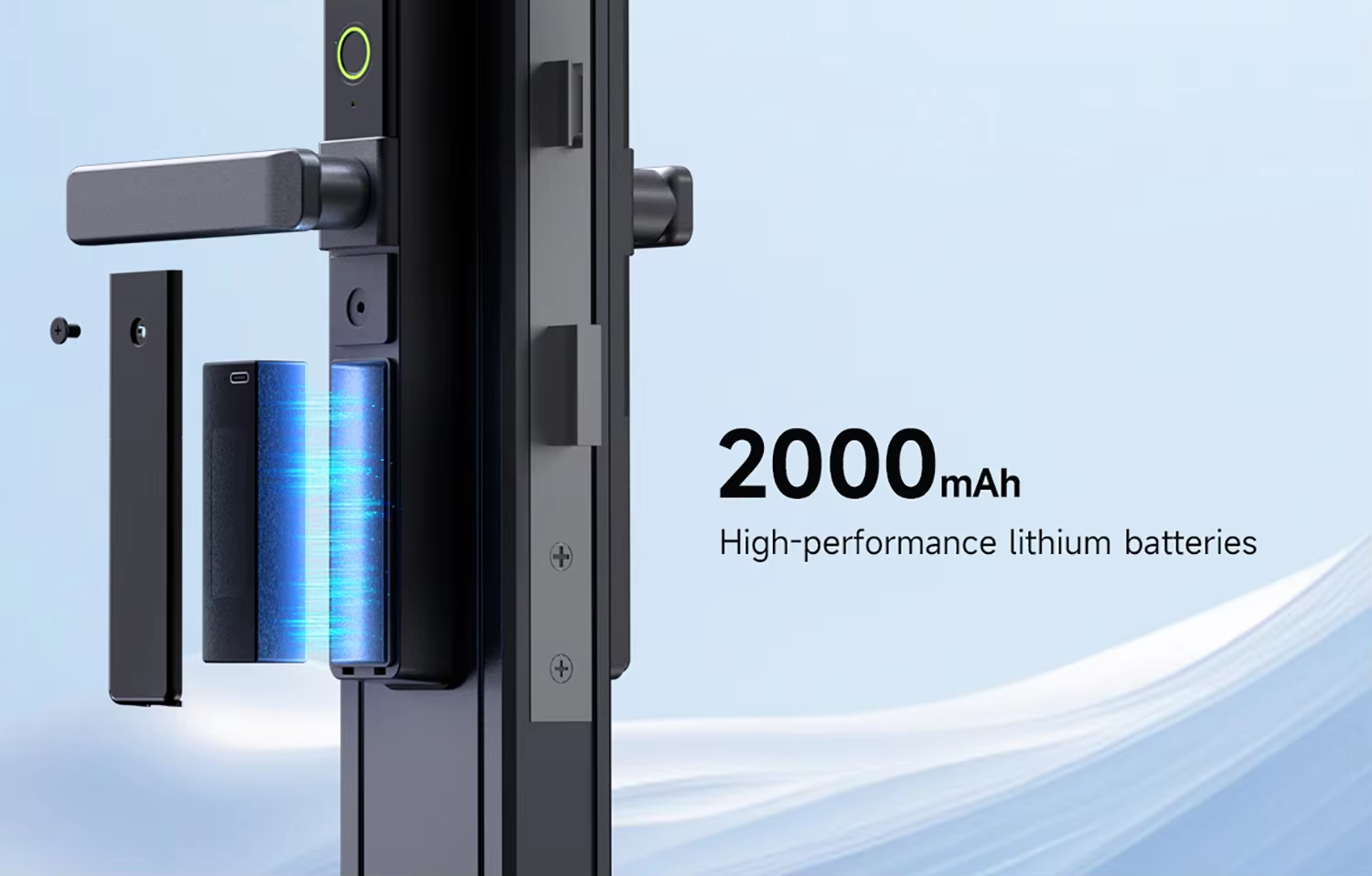
Lithium battery systems have become increasingly common in mid-to-high-end smart door lock designs due to their higher energy density and voltage stability.
There are two main lithium configurations in the market.
Rechargeable Lithium Battery Packs (Most Common)
This is currently the dominant lithium structure.
Typical specifications include:
3.7V single-cell systems
7.4V dual-cell systems
Capacity range: 4000mAh – 10000mAh
USB Type-C emergency charging port
Most smart locks using rechargeable lithium battery packs integrate a BMS (Battery Management System) for:
Overcharge protection
Over-discharge protection
Short-circuit protection
Temperature control
From a voltage behavior perspective, lithium batteries provide a relatively flat discharge curve. This means the voltage remains stable for most of the usage cycle and drops sharply only near depletion.
This stability is critical for:
Motor torque consistency
Fingerprint module accuracy
WiFi communication stability
Unstable voltage is one of the most common hidden reasons for declining smart lock battery life performance.
Replaceable Lithium Cells (Less Common)
Some manufacturers use replaceable lithium cells (such as 18650 types) instead of integrated battery packs.
Advantages include:
User-replaceable structure
High energy density
Longer lifecycle compared to alkaline
However, this approach increases structural complexity and cost.
Typical Lithium Smart Lock Battery Life
Under standard residential usage (8–15 unlocks per day):
Bluetooth-only locks: 8–12 months
WiFi-enabled locks: 6–10 months
Actual performance depends on:
Motor torque requirement
Standby current consumption
Network wake-up frequency
Ambient temperature
For example:
WiFi modules can consume 60–120mA in active mode
Bluetooth Low Energy standby can be below 1mA
Cold environments below -10°C can reduce lithium performance by 15–30%, but they still outperform alkaline batteries in low temperatures.
This is why lithium-based architecture is increasingly adopted in cold-region smart door lock solutions.
Advantages of Lithium Battery Architecture
Higher energy density
Stable voltage output
Better low-temperature tolerance
Rechargeable — lower long-term battery replacement cost
Cleaner internal layout (no multiple AA compartments)
From a distributor’s perspective, lithium systems often reduce complaints related to power instability within the first year of installation.
Limitations and Considerations
However, lithium batteries are not universally superior.
Key concerns include:
Higher initial cost
UN38.3 transport certification required for export
Air shipment restrictions
BMS dependency
Replacement pack sourcing control by manufacturer
Export compliance is especially important when scaling a LEROND access system overview or similar global supply chain operation.
Distributors must evaluate not only performance, but also:
Logistics cost
Spare battery strategy
Warranty structure
Lithium architecture improves performance stability, but it requires supply chain management discipline.
Alkaline Battery Smart Locks
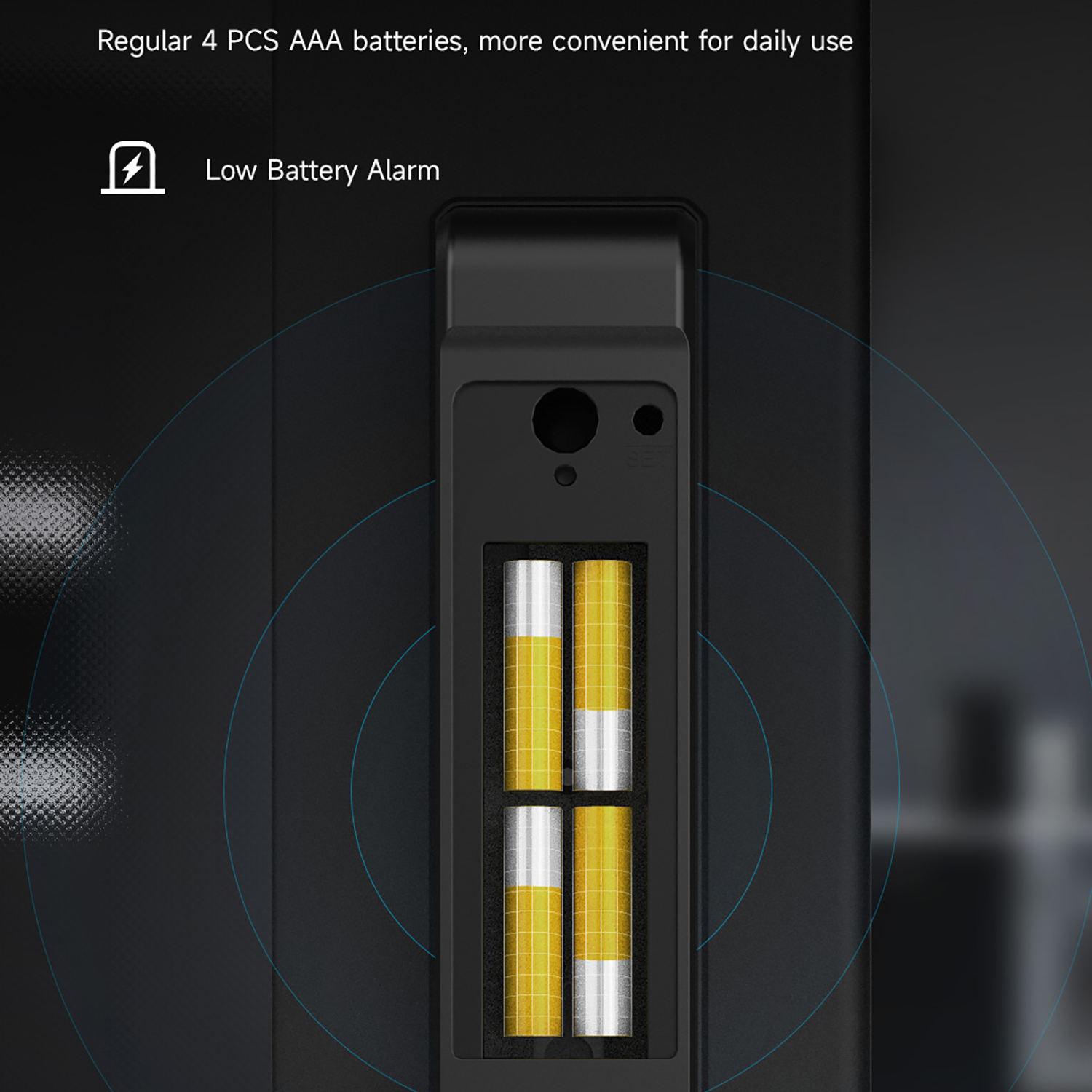
Alkaline batteries (typically AA or AAA) remain one of the most widely adopted power solutions in entry-to-mid-level smart locks.
Despite the rise of lithium systems, alkaline architecture continues to dominate certain markets due to cost efficiency and universal availability.
Let’s break down how they actually perform in real-world conditions.
Typical AA / AAA Configuration
Most alkaline-powered smart locks use:
4 × AA (6V system)
8 × AA (12V system for higher torque motors)
Occasionally 4–8 × AAA (lower torque, compact locks)
Standard AA alkaline battery capacity:
2000–3000mAh (depending on brand and discharge rate)
However, it is important to understand:
Alkaline batteries do not maintain stable voltage across their lifecycle.
Their discharge curve gradually declines from:
1.5V → 1.2V → 1.0V → 0.8V
As voltage drops, motor torque weakens, which may cause:
Slower unlocking speed
Increased failure rate under heavy latch pressure
Fingerprint sensor instability
WiFi reconnection delay
This gradual voltage decline is one of the main structural differences compared to lithium systems when evaluating smart lock battery life.
Real-World Battery Life of Alkaline Smart Locks
Under standard usage (8–15 unlocks/day):
Bluetooth-only lock: 6–10 months
WiFi lock: 4–8 months
Heavy usage (Airbnb, rental properties, offices):
3–6 months typical replacement cycle
Performance deteriorates significantly in cold weather:
Below 0°C:
Capacity reduction can exceed 40%
Internal resistance increases
Voltage drops faster under load
In cold regions, alkaline batteries may trigger “low battery warning” much earlier than expected.
For distributors serving Nordic, Canadian, or Eastern European markets, this becomes a structural after-sales issue.
Advantages of Alkaline Architecture
Low initial cost
No charging downtime
Global availability
No UN38.3 export compliance requirement
Easy end-user replacement
For emerging markets or projects with limited infrastructure, alkaline-powered locks still offer practical benefits.
In fact, for certain mass-market commercial smart door lock solutions, alkaline architecture can simplify logistics and inventory management.
Limitations of Alkaline Systems
However, from an engineering standpoint, alkaline systems present structural trade-offs:
Lower energy density
Unstable discharge curve
Weak low-temperature tolerance
Higher long-term replacement frequency
Risk of battery leakage if unused long-term
Leakage risk is particularly relevant in inventory turnover cycles exceeding 12 months.
Distributors must consider:
Warehouse storage conditions
Battery pre-installation policies
Post-sale replacement communication
Battery architecture is not just a hardware choice — it affects operational design within a complete smart door lock system architecture.
Technical Comparison: Lithium vs Alkaline
Below is a structured engineering comparison.
| Parameter | Lithium Battery | Alkaline Battery |
|---|---|---|
Energy Density |
High |
Medium–Low |
Discharge Curve |
Stable, flat |
Gradual decline |
Rechargeable |
Yes (most common) |
No |
Typical Capacity |
4000–10000mAh pack |
2000–3000mAh cell |
Low Temp Performance |
Usable to -20°C |
Significant decline below 0°C |
WiFi Stability |
Better voltage support |
May weaken near depletion |
Export Compliance |
Requires UN38.3 |
No special certification |
Replacement Frequency |
6–12 months |
4–8 months |
Initial Cost |
Higher |
Lower |
Long-Term Cost |
Moderate |
Moderate–High |
Important note:
Capacity comparison is not 1:1 because lithium systems often operate at different voltage structures. Direct mAh comparison can be misleading unless normalized by watt-hour (Wh).
This technical nuance is often ignored when discussing battery for smart lock performance.
How Battery Choice Directly Impacts Smart Lock Battery Life
Many distributors ask:
“Which battery lasts longer?”
The better question is:
“How does battery architecture interact with system power design?”
Smart lock power consumption comes from four primary modules:
Motor actuation (highest load spike)
Fingerprint / biometric sensor
Communication module (WiFi / BLE / Zigbee)
Standby microcontroller
Motor Power Spike
When unlocking, motor current may spike 500mA–1.2A momentarily.
If voltage drops under load:
Motor torque weakens
Unlock cycle extends
System retries → increases power consumption
Lithium’s stable discharge curve supports higher load stability, which directly improves practical smart lock battery life.
Communication Module Impact
WiFi-enabled smart locks consume significantly more power than Bluetooth-only models.
WiFi locks:
Active transmission: 60–120mA
Idle standby: 15–30mA
Bluetooth Low Energy:
Standby: <1mA
Active burst: 10–20mA
Therefore, battery architecture must match communication design.
A WiFi lock with alkaline batteries may experience noticeable reduction in runtime.
This is why evaluating the smart door lock power system holistically is more important than comparing battery type in isolation.
Standby Current and Firmware Optimization
Even a well-designed lithium system can underperform if:
Wake-up logic is inefficient
Sensors remain partially active
Cloud polling interval is too frequent
Battery choice is only one layer within an advanced smart door lock design.
Distributors who understand this structural interaction make better sourcing decisions.
Which Battery Architecture Is Better for Distributors?
There is no universal answer.
The better approach is to match battery architecture with project type, climate, usage frequency, and after-sales structure.
Below is a simplified decision framework.
Villa & Mid-to-High-End Residential Projects
Recommended: Lithium battery architecture
Reasons:
Stable motor torque for heavier doors
Better low-temperature tolerance
Premium positioning alignment
Reduced first-year service complaints
For distributors building a complete smart door lock system architecture, lithium often provides better consistency across different door conditions.
Cold Climate Markets
Recommended: Lithium
Alkaline capacity drops sharply below 0°C. In cold-region installations, lithium systems typically maintain more reliable smart lock battery life.
If your market includes Canada, Northern Europe, or high-altitude regions, lithium significantly reduces seasonal battery-related support cases.
High-Frequency Rental / Airbnb / Office Usage
Recommended: Lithium (WiFi models)
Frequent unlocking increases motor cycles and communication wake-ups. Voltage stability becomes critical.
Lithium’s flat discharge curve maintains consistent torque output even at lower charge levels.
Emerging Markets & Cost-Sensitive Projects
Recommended: Alkaline
Reasons:
Easy local battery sourcing
No charging downtime
Lower initial unit cost
No lithium export compliance complexity
For distributors prioritizing entry-level volume under commercial smart door lock solutions, alkaline remains viable.
Large Apartment Projects with Central Maintenance Teams
Hybrid approach may work:
Lithium for premium units
Alkaline for standardized large-volume doors
However, battery policy must align with warranty structure.
Inconsistent battery strategy often leads to unclear responsibility when evaluating smart lock battery replacement claims.
Frequently Asked Questions
How long does a smart lock battery really last?
Real-world smart lock battery life depends on:
Unlock frequency
Motor torque requirement
WiFi vs BLE usage
Ambient temperature
Firmware optimization
Average residential usage (8–15 unlocks/day):
Lithium WiFi lock: 6–10 months
Lithium BLE lock: 8–12 months
Alkaline WiFi lock: 4–8 months
Alkaline BLE lock: 6–10 months
Extreme cold or high-frequency usage can shorten lifespan by 20–40%.
Is lithium battery safer than alkaline in smart locks?
Modern lithium packs with integrated BMS are generally safe.
Safety depends on:
Overcharge protection
Over-discharge cutoff
Short-circuit design
Thermal protection
Alkaline batteries, while chemically stable, carry leakage risks if over-discharged or stored long-term inside the device.
Safety risk is less about chemistry and more about system design within the smart door lock power system.
Can a smart lock designed for alkaline batteries be upgraded to lithium?
Generally, no.
Voltage architecture differs:
4×AA alkaline = ~6V
Lithium pack systems may use 3.7V or 7.4V regulated output
Replacing battery type without circuit compatibility can damage the PCB or motor driver.
Battery architecture must match original advanced smart door lock design specifications.
Why does WiFi drain battery much faster than Bluetooth?
WiFi modules:
Maintain network handshake
Perform cloud polling
Transmit higher data loads
Bluetooth Low Energy:
Uses short burst communication
Maintains ultra-low standby current
WiFi-enabled models can consume 2–3× more power depending on firmware logic.
Battery selection must consider communication structure when optimizing smart lock battery life.
Do smart locks consume power when idle?
Yes.
Even in standby mode, the following components draw power:
Microcontroller
Touch panel sensor
Fingerprint wake-up circuit
Communication module
Standby current design is critical.
Poor firmware can shorten runtime regardless of battery chemistry.
What happens when the battery fully dies?
Most smart locks include:
Low battery warning (usually at 15–20% remaining)
Emergency Type-C power port
Mechanical key override
However, voltage drop behavior differs:
Lithium tends to drop sharply at end-of-life.
Alkaline declines gradually, sometimes causing unstable motor behavior before full depletion.
What certifications are required for exporting lithium battery smart locks?
Lithium battery shipments typically require:
UN38.3 transportation certification
MSDS documentation
Air freight compliance labeling
Alkaline battery shipments generally do not require special hazardous goods documentation.
Export compliance is an important factor when scaling a global LEROND smart door lock series distribution strategy.
Which battery type reduces long-term after-sales cost?
It depends on project context.
Lithium reduces:
Voltage instability complaints
Cold-weather issues
High-frequency drain cases
Alkaline reduces:
Initial procurement cost
Shipping complexity
Spare battery management
Long-term cost must be evaluated as Total Cost of Ownership (TCO) within your smart door lock guide strategy.
Final Thoughts: Battery Architecture Is a Strategic Choice
Battery architecture is not a cosmetic specification.
It influences:
Maintenance cycle
Climate adaptability
User experience
Logistics compliance
Warranty structure
Distributor support burden
When selecting or sourcing a smart lock, evaluate battery design as part of a complete smart door lock system architecture, not as an isolated technical detail.
To explore how power design integrates with communication protocols, motor systems, and structural compatibility, review our full smart lock portofilo for a deeper system-level understanding.
high-traffic commercial. Full OEM/ODM technical support.