Why Smart Door Lock Materials Matter More Than Marketing Claims
When evaluating smart door lock materials, many buyers focus on appearance, finish, or price. However, in professional applications—whether for distribution, residential projects, or large-scale developments—the material selection directly affects structural durability, corrosion resistance, lifecycle performance, and certification compliance.
Material choice is not simply an aesthetic decision. It determines:
Impact resistance
Housing rigidity
Corrosion performance in coastal environments
Long-term dimensional stability
Structural integrity under mechanical stress
In fact, material selection plays a critical role in meeting EN 1906 or ANSI Grade standards, especially when it comes to external panels and load-bearing components.
Yet the market is full of marketing phrases such as:
“Aviation aluminum body”
“Full metal housing”
“All-metal structure”
“Premium alloy construction”
These descriptions often lack technical definition. In many cases, “aviation aluminum” simply refers to standard 6063 aluminum extrusion—commonly used in window frames—not aerospace-grade materials. Similarly, “all-metal” may only apply to the outer visible panel, while the internal support structure relies heavily on ABS plastic.
This is why understanding smart door lock materials from a technical standpoint is essential for professional buyers.
If you need a broader framework for evaluating structure, certification, and engineering standards, refer to our Smart Door Lock Systems, which outlines structural requirements beyond surface material selection.
Overview of the Three Main Smart Door Lock Materials
In the current global market, three materials dominate smart lock housing construction:
Aluminum Alloy
Zinc Alloy
Stainless Steel (primarily 304 grade)
Each has distinct mechanical and economic characteristics.
Aluminum Alloy Smart Door Locks
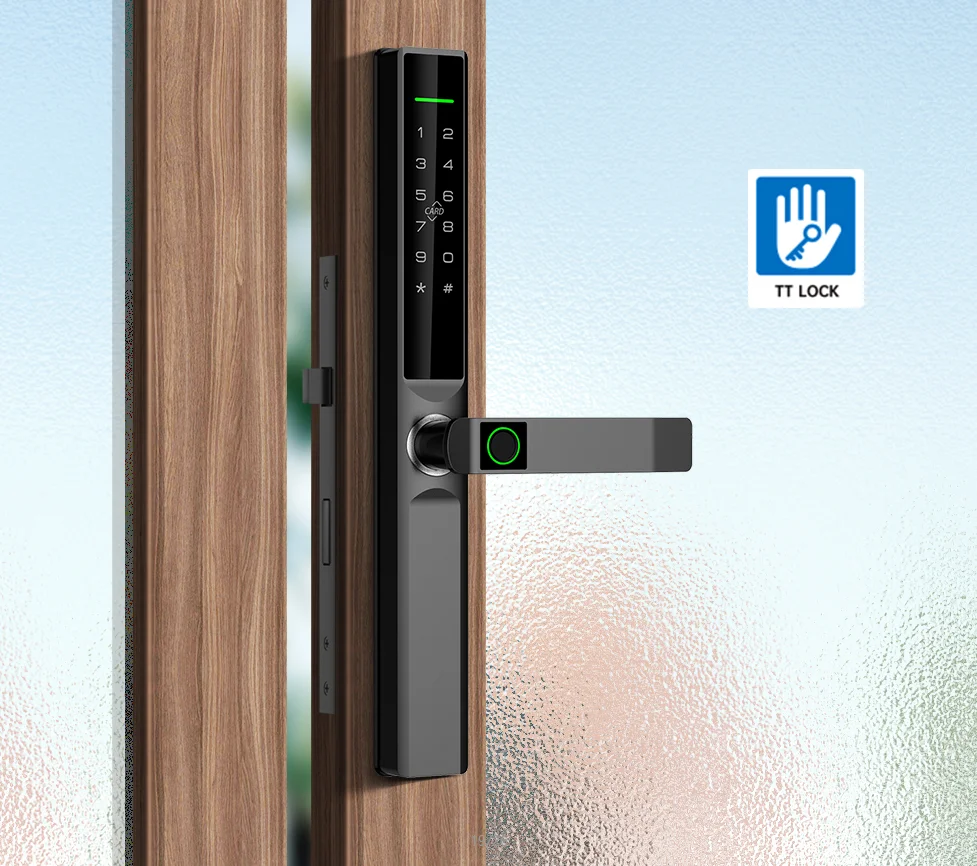
Aluminum alloy smart door locks are the most widely used configuration in the global market. The most common grades include 6061 and 6063 aluminum.
Mechanical Characteristics
Density: ~2.7 g/cm³
Tensile strength (6061-T6): 290–310 MPa
Corrosion resistance: Moderate
Processing: CNC machining, extrusion, die casting
(Reference data: ASM International Materials Database)
Aluminum offers a strong balance between weight, machinability, and cost efficiency. It allows manufacturers to achieve sleek designs with precise CNC finishing. Surface treatments typically include:
Anodizing
Powder coating
Spray painting
Because aluminum is lightweight, it is easier to install on slim aluminum or PVC doors, making it especially popular in Asian and emerging markets.
However, one critical issue often overlooked is panel thickness. Aluminum’s lower density means that thin panels may feel structurally weaker if not properly reinforced. In some cost-driven products, front panels may be reduced to 1.2–1.5 mm thickness, which significantly reduces impact resistance compared to 2.0 mm or higher industrial-grade panels.
We will analyze thickness and structural reinforcement in detail later in this article.
Zinc Alloy Smart Door Locks
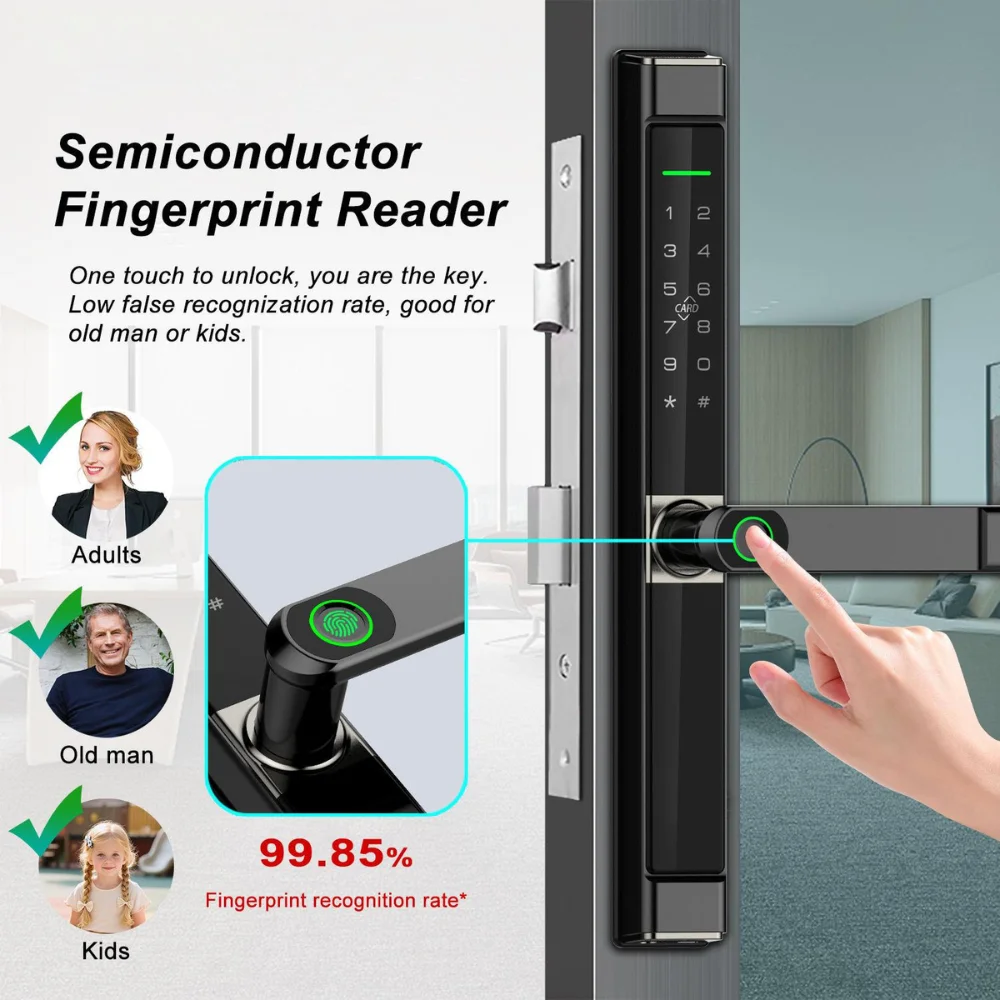
Zinc alloy smart door locks are typically manufactured using Zamak-based die-casting alloys (commonly Zamak 3 or Zamak 5).
Mechanical Characteristics
Density: 6.6–7.0 g/cm³
Tensile strength: 280–350 MPa
Casting precision: High
Surface finishing compatibility: Excellent
Zinc alloy is significantly heavier than aluminum, which gives products a solid and premium tactile feel. Because zinc is ideal for high-pressure die casting, smart door manufacturers can produce complex shapes with tight tolerances and refined decorative details.
Zinc alloy smart door locks are often favored in mid-to-high-end European residential markets due to:
Better perceived quality
Superior electroplating results
Heavier and more solid touch feedback
However, zinc alloy generally carries higher raw material and processing costs compared to aluminum. Additionally, zinc is more brittle under extreme impact compared to stainless steel, which must be considered in high-security applications.
Stainless Steel Smart Door Locks (304 Grade)
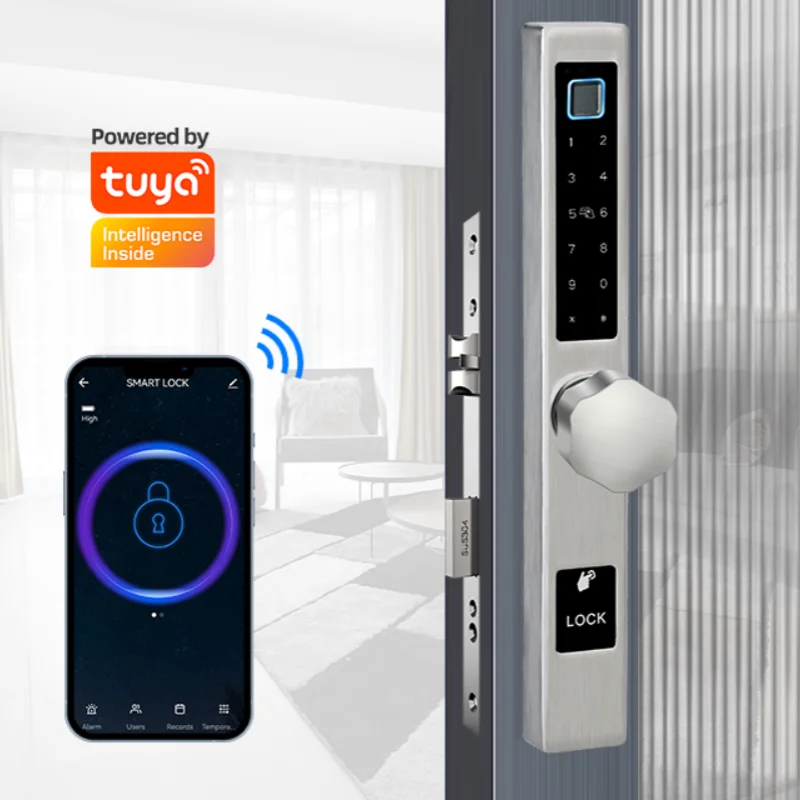
Stainless steel smart door locks—particularly those using 304 stainless steel—are increasingly preferred in North American and European markets.
It is important to distinguish 304 stainless steel from 201 stainless steel.
304 Stainless Steel (AISI 304)
Chromium: ~18%
Nickel: ~8%
Density: ~8.0 g/cm³
Tensile strength: 515–620 MPa
Corrosion resistance: High
201 Stainless Steel
Lower nickel content
Reduced corrosion resistance
Lower cost
The higher nickel and chromium content in 304 stainless steel significantly improves corrosion resistance, especially under salt spray testing conditions (ASTM B117). While aluminum and zinc alloys may withstand 48–120 hours in neutral salt spray tests depending on coating, 304 stainless steel components can exceed 240 hours under similar conditions.
For coastal, humid, or high-traffic environments, stainless steel provides superior long-term durability and structural rigidity.
Another important factor is load-bearing strength. With tensile strength exceeding 500 MPa, stainless steel offers superior resistance to deformation compared to aluminum or zinc alloys.
For buyers evaluating compliance and long-term reliability, understanding these structural benchmarks is critical. You may refer to our smart door lock structural standards for a deeper breakdown of material performance within certification frameworks.
At this stage, we have examined the three primary material categories used in modern smart door lock materials. However, material type alone does not determine quality.
Two aluminum locks can perform completely differently.
Two stainless steel locks can vary dramatically in durability.
In the next section, we will compare these materials side by side using technical data and then examine the often-overlooked factor that truly determines performance: material thickness and internal structural integrity.
Technical Comparison: Aluminum vs Zinc vs Stainless Steel
To move beyond marketing descriptions, professional buyers must evaluate smart door lock materials through measurable engineering properties.
Below is a technical comparison based on publicly available material data (ASM International, ASTM standards, ISO 9227 corrosion testing framework).
Core Mechanical & Physical Comparison
| Property |
Aluminum Alloy (6061/6063) |
Zinc Alloy (Zamak 3/5) |
SUS304 Stainless Steel |
|---|---|---|---|
Density |
~2.7 g/cm³ |
6.6–7.0 g/cm³ |
~8.0 g/cm³ |
Tensile Strength |
200–310 MPa |
280–350 MPa |
515–620 MPa |
Hardness (Brinell) |
~95 HB |
~82–100 HB |
~201 HB |
Corrosion Resistance |
Moderate |
Moderate |
High |
Salt Spray Resistance* |
48–120h (coated) |
72–120h (coated) |
240h+ |
Machining Cost |
Low |
Medium–High |
Medium |
Weight Feel |
Light |
Heavy |
Heavy |
Structural Rigidity |
Medium |
Medium |
High |
*Salt spray testing reference: ASTM B117 / ISO 9227 neutral salt spray method.
What These Numbers Actually Mean
Density affects weight and tactile perception.
Zinc alloy and stainless steel feel heavier, which many markets associate with “premium quality.” Aluminum feels lighter but can still perform well structurally if thickness is adequate.
Tensile strength determines resistance to deformation under stress.
304 stainless steel offers nearly double the tensile strength of typical aluminum alloys, making it more resistant to bending or forced impact on front panels.
Corrosion resistance depends not only on base material but also on coating quality. Aluminum and zinc alloy rely heavily on surface treatment performance. Stainless steel provides intrinsic corrosion resistance due to its chromium oxide passive layer.
However, numbers alone do not tell the full story.
Material grade and structural design must work together.
For a deeper breakdown of how these parameters integrate into real-world structural engineering, refer to our complete smart door lock engineering guide, which explains how housing materials interact with internal reinforcement systems.
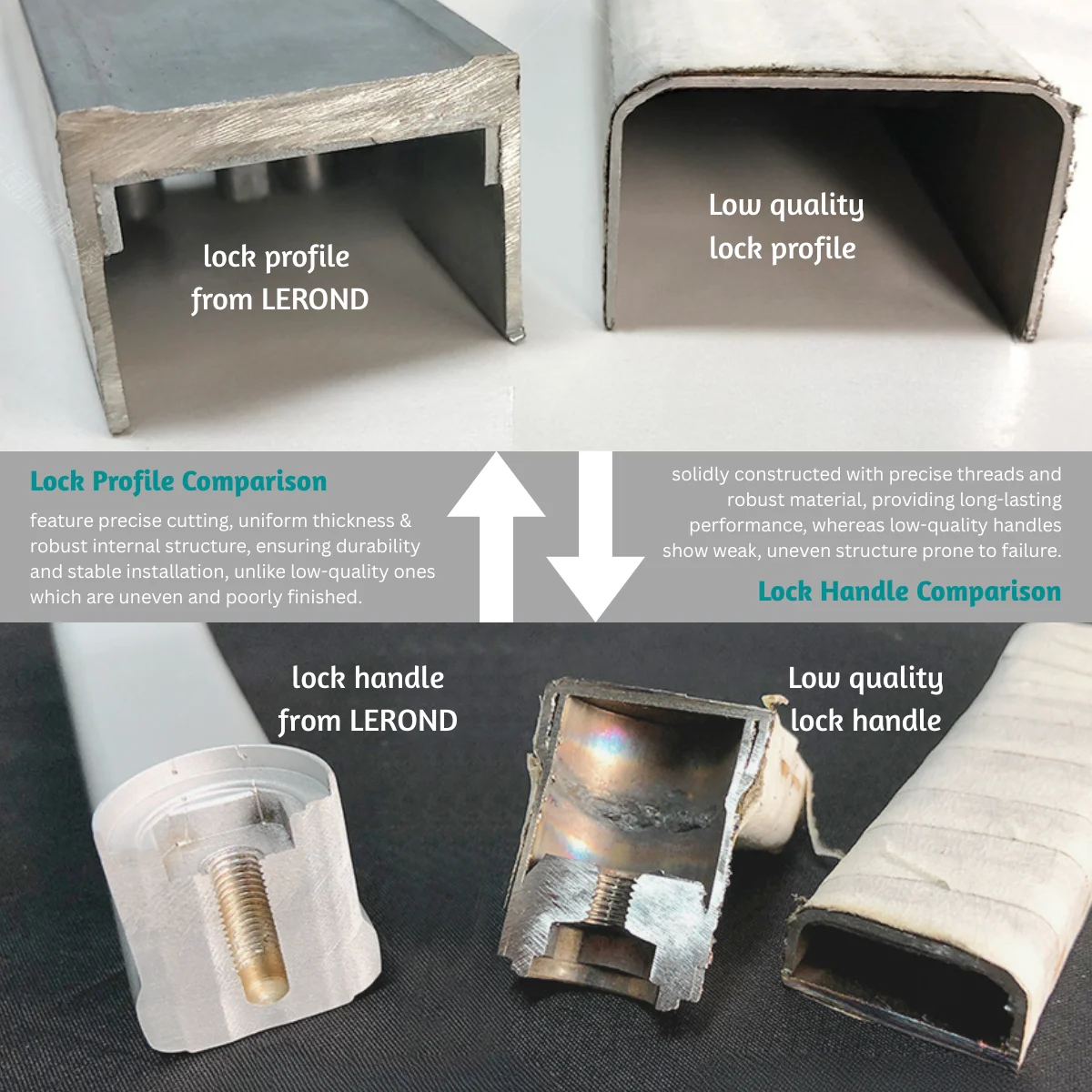
Material Thickness & Structural Integrity: The Hidden Cost Factor
This is where most purchasing decisions go wrong.
Two locks may both be advertised as:
“Aluminum alloy smart door locks”
“304 stainless steel smart door locks”
“Full metal body construction”
Yet their real-world durability can differ significantly.
Why?
Because material thickness and internal structure often matter more than material category alone.
Thickness Variation: A Critical Difference
In aluminum alloy smart door locks, front panel thickness commonly ranges between:
1.2 mm (cost-optimized models)
1.5 mm (mid-tier models)
2.0 mm or above (project-grade models)
A reduction from 2.0 mm to 1.2 mm can reduce material cost by 20–30% per housing component depending on dimensions. Across mass production, this becomes significant.
However, thinner panels:
Reduce impact resistance
Increase flex under pressure
Lower perceived solidity
Affect long-term screw retention stability
The same applies to zinc alloy and stainless steel housings. Stainless steel with 0.8 mm thickness does not outperform a 2.0 mm aluminum structure with proper reinforcement.
Material category alone is insufficient for evaluation.
Internal Frame vs Decorative Shell
Another overlooked issue is internal support structure.
Some products use:
Thin metal outer plates
ABS plastic internal frames
Plastic screw anchoring points
Yet they may still be marketed as “all-metal smart locks.”
In reality, the visible front panel may be aluminum, while the internal load-bearing frame is polymer-based.
Under repeated torque stress (handle rotation cycles, door slamming), plastic support structures may degrade faster than reinforced metal frames.
Professional buyers should verify:
Is the internal chassis metal or polymer?
Are screw fixation points reinforced?
Is there a steel backbone plate?
Are high-stress zones double-layered?
This structural transparency is part of responsible manufacturing standards. Our smart lock manufacturing standards explain how internal metal reinforcement improves lifecycle durability in high-frequency usage environments.
ABS Usage: When Is It Acceptable?
ABS is not inherently “bad.”
It is widely used in:
Battery compartments
Decorative trim
Internal PCB housing
However, ABS should not replace load-bearing components in external panels or handle transmission areas.
The issue arises when:
Large surface areas are plastic
Marketing claims imply full aluminum construction
Weight reduction is disguised as “lightweight innovation”
Material transparency is a key indicator of supplier credibility.
Why Stainless Steel Can Sometimes Cost Less Than Aluminum
At first glance, stainless steel appears more expensive due to raw material pricing.
However, supply chain structure changes cost dynamics.
Manufacturers specializing in stainless steel smart door locks often:
Purchase large-volume stainless sheets
Use dedicated cutting and forming lines
Optimize tooling for one material category
Meanwhile, aluminum-focused suppliers may procure stainless steel in smaller batches, leading to:
Higher raw material procurement cost
Lower production efficiency
Higher rejection rates
Therefore, in some cases, stainless steel smart door locks can be priced competitively—sometimes even below high-finish aluminum models.
This is not purely a material issue. It is a supply chain specialization issue.
For buyers developing long-term distribution strategies, understanding this economic layer is part of effective Smart Door Lock Selection Framework planning.
At this point, we have covered:
Mechanical comparison
Thickness impact
Internal structure transparency
Supply chain economics
In the final section, we will focus on:
How to choose material based on market positioning
Use-case decision matrix
Detailed FAQ (technical verification questions buyers should ask suppliers)
Which Smart Door Lock Material Should You Choose?
Material selection should never be based solely on cost or perceived weight. Instead, professional buyers should evaluate smart door lock materials through three dimensions:
Market positioning
Environmental exposure
Structural durability requirements
Below is a simplified decision matrix used in professional procurement analysis.
Cost-Sensitive Emerging Markets
Recommended: Aluminum Alloy (≥1.8–2.0 mm thickness)
Why:
Lower machining cost
Lightweight for aluminum/PVC doors
Easier installation
Acceptable corrosion resistance with proper coating
Key requirement:
Ensure internal reinforcement is metal-based and not primarily ABS-supported.
Mid-Range Residential Distribution
Recommended: Zinc Alloy or Reinforced Aluminum
Why:
Better tactile perception
Stronger perceived value
More decorative finishing options
Zinc alloy smart door locks are often well-received in European-style residential projects due to their heavier feel and electroplating aesthetics.
High-End EU & North American Projects
Recommended: 304 Stainless Steel
Why:
Superior corrosion resistance
Higher tensile strength
Better compliance positioning for ANSI/EN expectations
Long-term structural stability
In coastal or high-humidity environments, stainless steel smart door locks significantly reduce long-term service risks.
For a comprehensive engineering-based procurement checklist, refer to LEROND Smart Door Lock Selection, which integrates structural durability with certification alignment.
High-Traffic Commercial or Multi-Family Buildings
Recommended: Reinforced Stainless Steel with Metal Internal Chassis
Why:
Higher cycle testing durability
Better resistance to repetitive torque stress
Reduced long-term maintenance
For technical specification alignment, see our advanced smart lock structural guide for a breakdown of reinforcement benchmarks.
Frequently Asked Questions
Is “aviation aluminum” really aerospace-grade material?
In most consumer and mid-range smart locks, “aviation aluminum” refers to 6063 or 6061 aluminum alloys. These are excellent industrial materials but are not aerospace-certified alloys such as 7075-T6 used in aircraft structural components. The term is largely marketing-oriented.
Is zinc alloy stronger than stainless steel?
No. While zinc alloy has decent tensile strength (up to ~350 MPa), 304 stainless steel typically exceeds 500 MPa. Zinc feels heavier but does not outperform stainless steel in structural strength.
Does heavier always mean more secure?
Not necessarily. Density affects weight perception, but security depends on:
Thickness
Internal reinforcement
Fixation structure
Locking mechanism integrity
A thick aluminum structure with proper metal chassis may outperform a thin stainless decorative shell.
Is 201 stainless steel acceptable for smart locks?
201 stainless steel contains lower nickel content, reducing corrosion resistance compared to 304. It may be acceptable for indoor applications but is generally not recommended for humid or coastal environments.
How can buyers verify real material composition?
Professional buyers should request:
Material certificate (Mill Test Report)
Salt spray test report (ASTM B117 / ISO 9227)
Cross-section thickness drawings
Internal structural photos
Transparency is a sign of manufacturing maturity.
For more verification criteria, see our professional smart lock material analysis resource.
How important is panel thickness?
Extremely important. For external panels, 1.8–2.0 mm is commonly considered project-grade. Thickness below 1.5 mm significantly reduces rigidity unless reinforced internally.
Can ABS be used in smart locks?
Yes, but not as a primary load-bearing structural component. ABS is suitable for internal covers or battery compartments but should not replace metal reinforcement in high-stress zones.
Why do some stainless steel locks cost less than aluminum models?
Cost depends on supplier specialization, procurement scale, tooling optimization, and production efficiency—not just raw material price. Supply chain structure plays a decisive role.
Final Thoughts: Material Is Only One Dimension
Choosing the right smart door lock materials requires balancing:
Mechanical performance
Environmental durability
Thickness and structural integrity
Market positioning
Supply chain capability
Material alone does not guarantee quality. Engineering design, reinforcement strategy, and production transparency define long-term performance.
Technical Consultation
Need a detailed breakdown of housing thickness, internal reinforcement, and material suitability for your target market?
Request our engineering specification checklist for OEM and distribution projects.
Our technical team can help align material selection with your market positioning and long-term durability requirements.
high-traffic commercial. Full OEM/ODM technical support.